
Overview
Table of Contents Hide
- This article explains how AEO and GEO reshape search visibility in AI-driven platforms, where AEO focuses on direct answers and GEO on inclusion in AI-generated responses.
- It outlines key post-audit metrics, including AI citations, content performance, engagement, and technical health, emphasizing continuous optimization to improve visibility, authority, and AI recognition.
As AI-driven platforms reshape how users search and interact with content, Answer Engine Optimization (AEO) and Generative Engine Optimization (GEO) have become increasingly important. AEO focuses on delivering direct answers, while GEO supports inclusion in AI-generated responses. Because these strategies go beyond traditional SEO, regular audits are essential to evaluate how effectively AI systems interpret, select, and surface your content.
In this article, we will explore key metrics to track after an AEO and GEO audit to measure and improve your visibility.
Key Metrics to Track After an AEO and GEO Audit
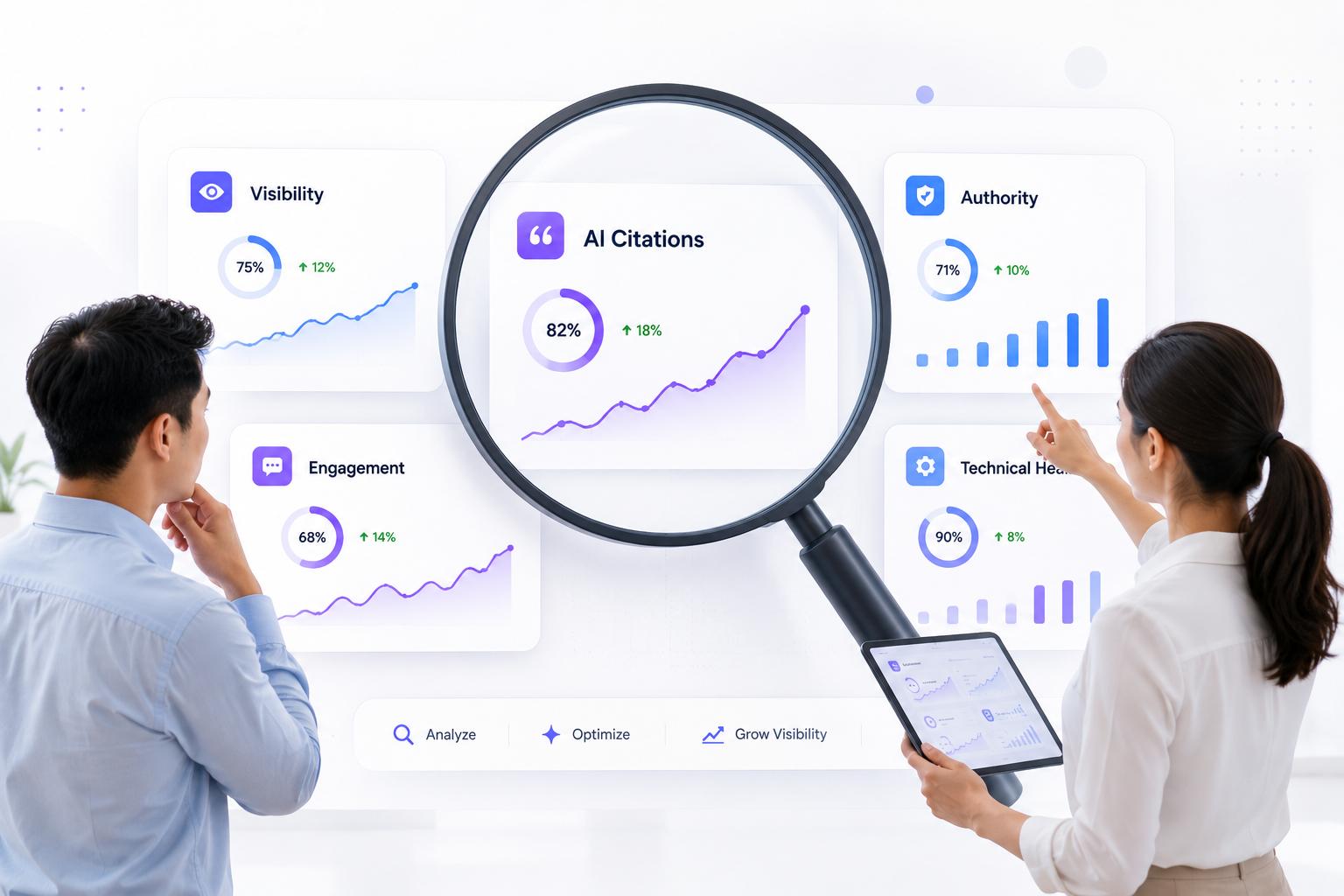
Here are the key metrics used to evaluate how well your content performs across AI-driven search systems and traditional organic visibility.
AI Visibility and Citation Metrics
This measures how often your content appears or is referenced within AI-generated responses and search answer features. It includes visibility in featured snippets, AI overviews, and conversational platforms where content is summarized instead of being clicked.
Citation tracking focuses on whether your brand or pages are used as sources in AI-generated outputs, compared with competitors. Strong performance here indicates that your content is trusted, structured well, and easy for AI systems to extract. Low visibility suggests gaps in authority, unclear formatting, or insufficient alignment with how AI systems interpret and select information for answers.
Content and Entity Performance
Individual pages, topics, and brand entities are evaluated based on how well they are understood and represented across search and AI systems. It tracks keyword-to-content alignment, topic coverage, and whether your brand is recognized as a relevant entity in your niche.
Strong performance means your content clearly defines concepts, answers related questions, and reinforces topical authority. It also includes monitoring how often your brand is mentioned alongside key industry terms.
Weak performance usually signals shallow content depth, poor internal linking, or a lack of contextual relevance, making it harder for AI systems to confidently associate your brand with specific topics or queries.
Traffic and Conversational Engagement
Engagement after users discover your content through search or AI-driven results is measured through key signals that reflect content effectiveness. According to Semrush’s 2026 data, nearly 60% of Google searches now result in zero clicks, highlighting the growing importance of visibility within search results themselves.
These signals include organic traffic trends, click-through rates, bounce rates, and engagement depth, such as scroll behavior and time on page. Conversational engagement focuses on how well content responds to natural, question-based queries that users type or speak into AI tools. High performance indicates strong relevance and clarity, while low engagement suggests misaligned intent or weak structure.
Technical and Foundational Metrics
Website structure health is measured by how easily search engines and AI systems can access, crawl, and interpret content. It includes page speed, mobile usability, crawlability, indexing status, and Core Web Vitals performance.
Structured data usage, such as schema markup, is also evaluated to ensure the content context is clearly defined for machines. Strong technical performance enables faster discovery and more accurate interpretation of pages.
Poor technical signals can block or limit visibility, even when content quality is strong. These metrics form the foundation that determines whether AEO and GEO efforts can perform effectively at scale.
How to Measure AEO vs GEO Performance
Here’s how to evaluate how your content performs across both answer engines and generative AI platforms to understand where visibility is strongest and where improvements are needed.
| Category | Measurement Area | Description |
|---|---|---|
| AEO | Featured Snippets | Tracks whether your content appears in position zero results with direct answers pulled from your page. |
| Direct Answer Placements | Measures visibility in instant answers, People Also Ask boxes, and other answer-focused SERP features. | |
| Voice Search Visibility | Evaluates whether your content is optimized and selected for spoken queries by voice assistants. | |
| GEO | AI Citations | Tracks how often your content or brand is cited in AI-generated responses across platforms. |
| Content Reuse in Summaries | Measures whether your content is paraphrased, summarized, or embedded in AI-generated answers. | |
| Brand Presence in Generative Platforms | Evaluates how frequently your brand appears in AI tools and conversational search environments. |
Tools to Track AEO & GEO Metrics

These tools help measure how your content performs across traditional search engines and AI-driven platforms.
Provides data on impressions, clicks, and search visibility, helping identify which queries trigger your content in search results.
- Google Analytics
Tracks user behavior such as traffic sources, engagement, and conversions to evaluate content performance after discovery.
- SEO tools (Ahrefs, SEMrush)
Offer insights into keyword rankings, backlinks, and competitor visibility to assess overall SEO and AEO strength.
- Manual AI testing (ChatGPT, search assistants)
Involves directly checking AI platforms to see if your content or brand appears in generated answers or recommendations.
Optimize and Track AEO Performance with SEO Hacker
At SEO Hacker, we optimize and track AEO performance by combining structured content strategy, technical precision, and continuous data analysis to ensure your brand stays visible across both search engines and AI-driven platforms.
We monitor key signals like featured snippet visibility, AI citations, organic engagement, and keyword intent coverage to understand how your content is performing in real time. From there, we refine your pages by providing clearer answers, improving structure, implementing schema, and building authority.
This ongoing process ensures your content doesn’t just rank; it gets selected, referenced, and surfaced as a trusted answer across evolving search and generative systems.
Key Takeaway
Tracking the key metrics to track after an AEO and GEO audit is essential for understanding how your content performs across both traditional search engines and AI-driven platforms. These metrics reveal whether your pages are being seen as direct answers, referenced in AI-generated responses, and engaged with by real users.
If you’re ready to turn insights into measurable results, SEO Hacker can help you track, optimize, and scale your AEO and GEO performance. Get in touch today to build a stronger foundation for visibility across search engines and AI-powered platforms.