Overview
- AI-driven search is changing how customers research products, compare providers, and find businesses, making it important to assess your brand’s visibility beyond traditional search rankings.
- Before hiring an agency, your business should have a reliable SEO foundation, useful website content, consistent business information, and clear marketing objectives.
- Preparing your website, internal resources, and performance benchmarks helps an agency develop a more focused SEO, AEO, and GEO strategy.
Investing in AI SEO requires more than hiring specialists or adopting new optimization tools. Your website needs a reliable technical foundation, your content must address relevant customer questions, and your brand information should remain accurate across online platforms.
These elements influence how search engines and AI systems interpret your business, so preparing them before launching a campaign can make optimization more effective. If you’re considering working with an AI SEO agency, one important question to ask is: Is your business ready for AI SEO?
Assessing your current digital presence, marketing goals, and internal resources can help you identify gaps and decide what needs attention before an agency implements your strategy.
Core Signs Your Business Is AI-Ready
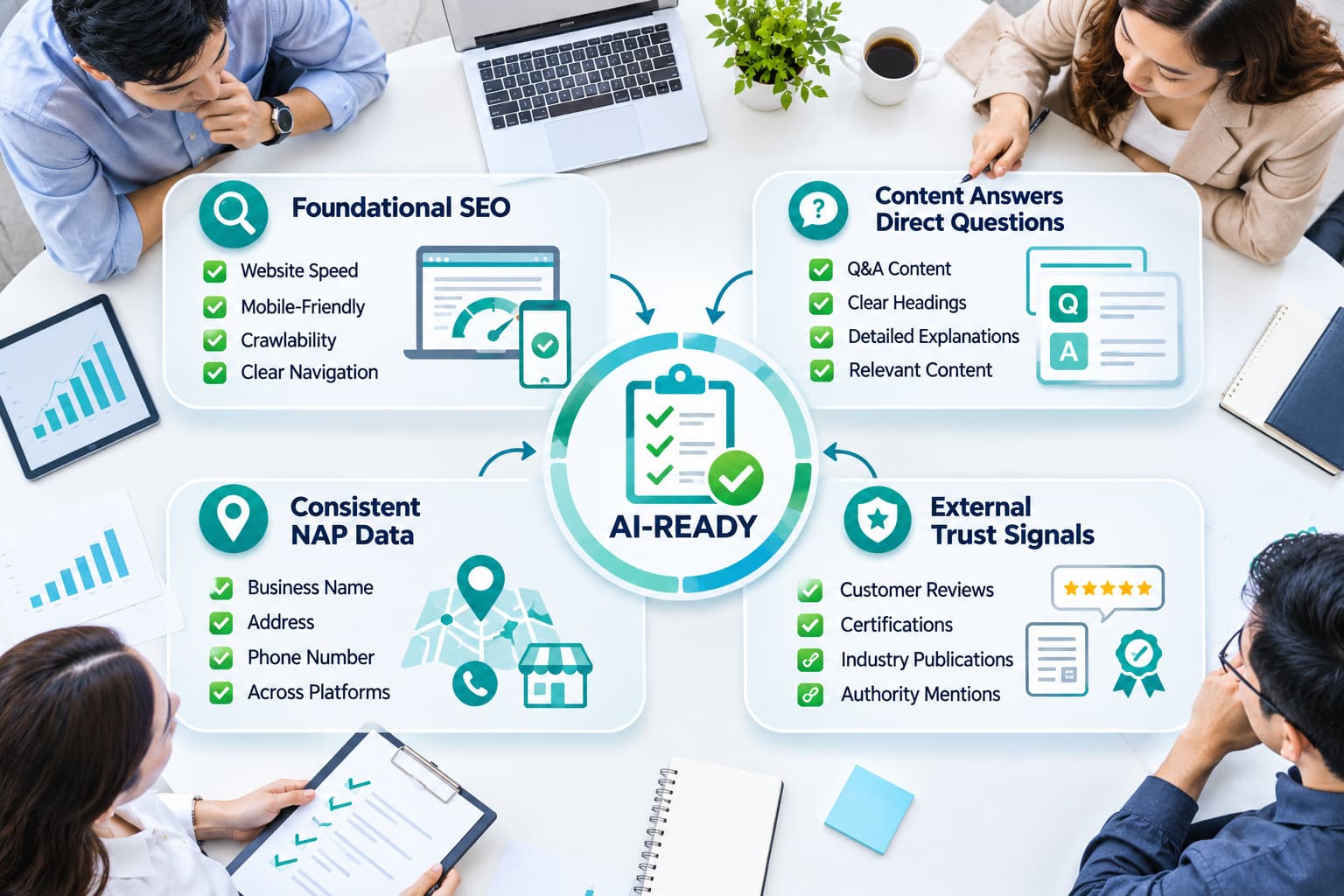
A business does not need a perfect website or an established AI search presence before investing in optimization, but certain foundations make the process more effective.
Foundational SEO Is Intact
Your website loads quickly, works properly on mobile devices, and has a clear navigation structure. Important pages are accessible through internal links, URLs follow a logical hierarchy, and search engines can crawl and index your main content without recurring errors.
You may also notice that your service pages appear in relevant Google search results and that visitors can move between related pages without encountering broken links or confusing navigation.
These are signs that your website has an established SEO foundation. While technical issues may still exist, its overall structure supports search engine access and content discovery.
Content Answers Direct Questions
Instead of focusing only on target keywords, your website answers the specific “who, what, where, and why” questions your customers actually ask. Your service pages explain who your offering is for, what it includes, where it is available, and why it addresses a particular need. Visitors can find these answers without piecing together information from several unrelated pages.
A software company’s website must clearly define target teams, core use cases, key features, implementation steps, and pricing factors. Complementary content should directly answer targeted customer and industry questions rather than rely on broad promotional topics.
Your content uses descriptive headings, defines technical terms, and provides relevant details to support its claims. These are visible signs that your website provides direct, useful answers that readers can understand and search engines and AI platforms can interpret.
Consistent NAP (Name, Address, Phone) Data
Your company’s name, address, and phone number match across your website, Google Business Profile, and relevant business directories. Your contact details are current, with no conflicting addresses, outdated phone numbers, or variations in your registered business name.
For businesses with multiple branches, each location has accurate contact information and a clearly defined service area. Your Google Business Profile also reflects the correct operating hours and location details.
This consistency gives customers and search platforms reliable information when identifying your business, particularly for local searches. Google’s Business Profile guidelines require accurate business names, addresses or service areas, categories, and location details, and advise chains to keep names and categories consistent.
External Trust Signals
Off-site presence—such as industry publications, verified reviews, accurate directory listings, case studies, and professional certifications—validates your brand’s authority. These external references reinforce your team’s expertise and support the credibility of the information on your website.
For instance, a healthcare provider may have consistent practitioner profiles, verified professional credentials, and mentions from reputable medical organizations. This third-party information can influence how search engines and AI platforms assess and represent the brand. While these signals do not guarantee AI citations, they provide a stronger basis for establishing online authority.
What to Prepare Before Hiring an Agency?
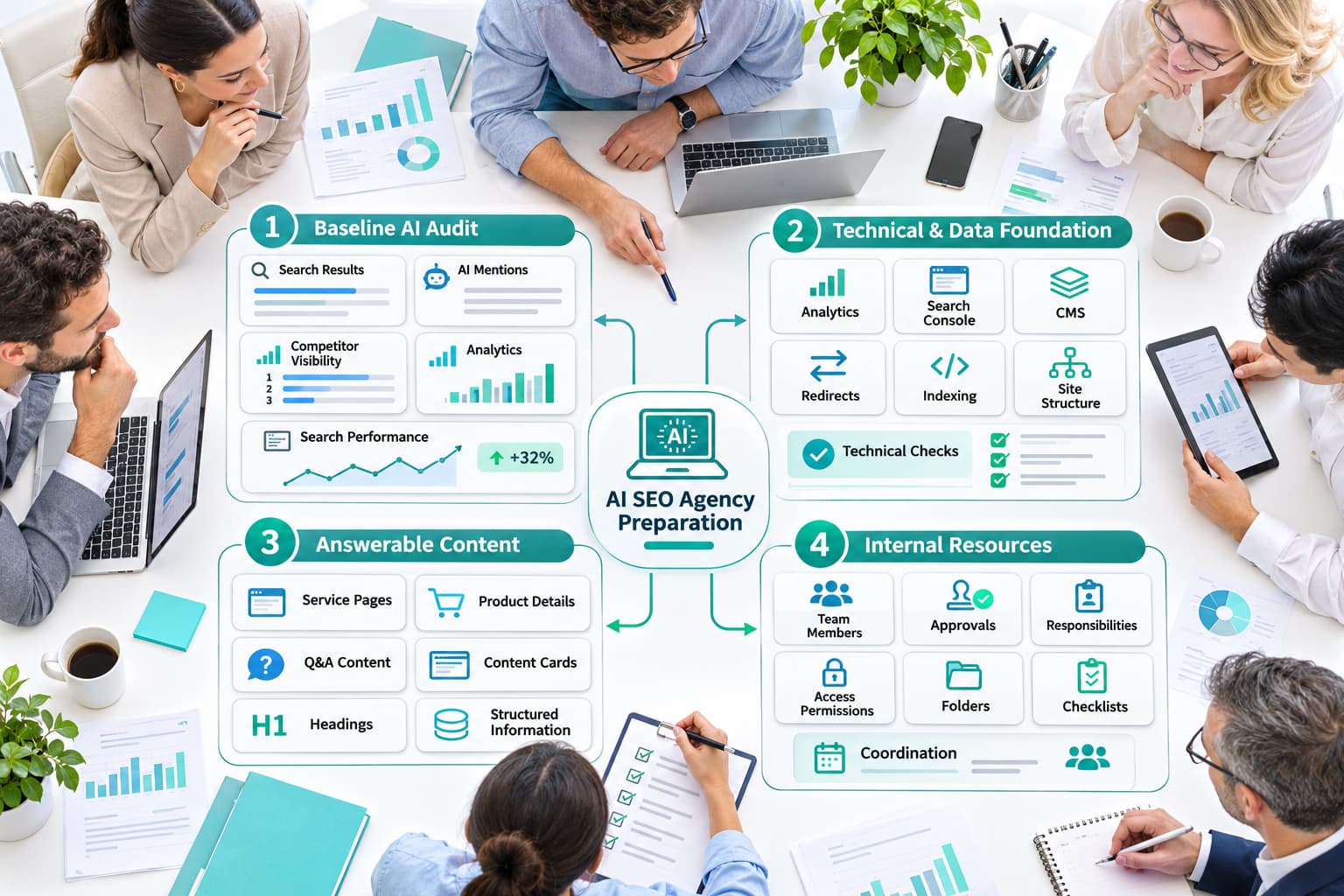
Once you have assessed your current position, organize the information and resources an agency needs to evaluate your website and develop an optimization strategy.
Conduct a Baseline AI Audit
Before an agency begins optimizing your website, establish how your brand currently appears across traditional search engines and AI platforms. Ranking well on Google does not automatically guarantee visibility in AI-generated answers.
A 2026 study of 863,000 keywords found that only around 38% of AI Overview citations came from pages ranking in Google’s top 10 results. This highlights the need to assess your visibility beyond conventional rankings.
Search relevant customer questions on ChatGPT, Gemini, and Perplexity, then record whether your brand appears, which competitors are mentioned, and whether the information is accurate. Review your Google rankings, organic traffic, and conversion data to establish a baseline and identify opportunities across SEO, AEO, and GEO
Clean Up Your Technical and Data Foundation
Prepare accurate website information and access to the platforms an agency needs to assess your performance. Your website should have no major unresolved issues involving broken links, indexing, outdated pages, inconsistent business details, or incorrect structured data.
Organize access to Google Analytics 4, Google Search Console, your content management system, and relevant SEO tools. If your website recently underwent a redesign, provide details about URL changes, redirects, and migrated content. These resources help the agency evaluate your existing foundation and identify technical issues that may affect search visibility.
Restructure Your Content for Answerability
Review whether your website content answers specific customer questions or focuses mainly on target keywords. Product and service pages should explain what you offer, who it serves, and how it addresses customer needs.
A business loan page, for example, can cover eligibility, required documents, repayment terms, and application steps. Organize content with clear headings and complete, easy-to-follow explanations.
Prepare accurate product specifications, company background information, service descriptions, and subject matter expertise for the agency. These materials help ensure that new or revised content reflects your actual business capabilities.
Prepare Internal Resources for the Agency
AI SEO often involves coordination across marketing, IT, and subject matter experts. Assign a primary contact to manage agency requests, provide feedback, and connect specialists with the right departments.
Identify who will approve content, provide website access, implement technical changes, and verify business-specific information. Establish realistic approval timelines and clarify who has authority to make decisions.
These responsibilities help the agency move through audits, content development, and optimization without unnecessary delays. Clear internal processes also make it easier to address recommendations that require input or implementation from different teams.
What to Expect in the First 90 Days
The exact timeline depends on your website’s condition, campaign scope, industry competition, and available resources. These milestones represent an initial implementation framework, not a guarantee of rankings, citations, or traffic growth within 90 days.
- Month 1: Audit, Tracking Setup, and Quick Technical Wins. The agency reviews your website, evaluates existing search performance, establishes AI visibility benchmarks, and addresses priority technical issues that could limit discoverability.
- Month 2: On-Page Optimization, Local SEO, and Content Plan. Specialists improve priority pages, refine business information, address local search opportunities, and develop content around relevant customer questions and search intent.
- Month 3: Momentum, Internal Linking, and Authority Building. The agency expands content coverage, strengthens connections between related pages, and develops strategies for improving your brand’s credibility and visibility across relevant search and AI platforms.
How SEO Hacker Helps Businesses Get Ready for AI SEO
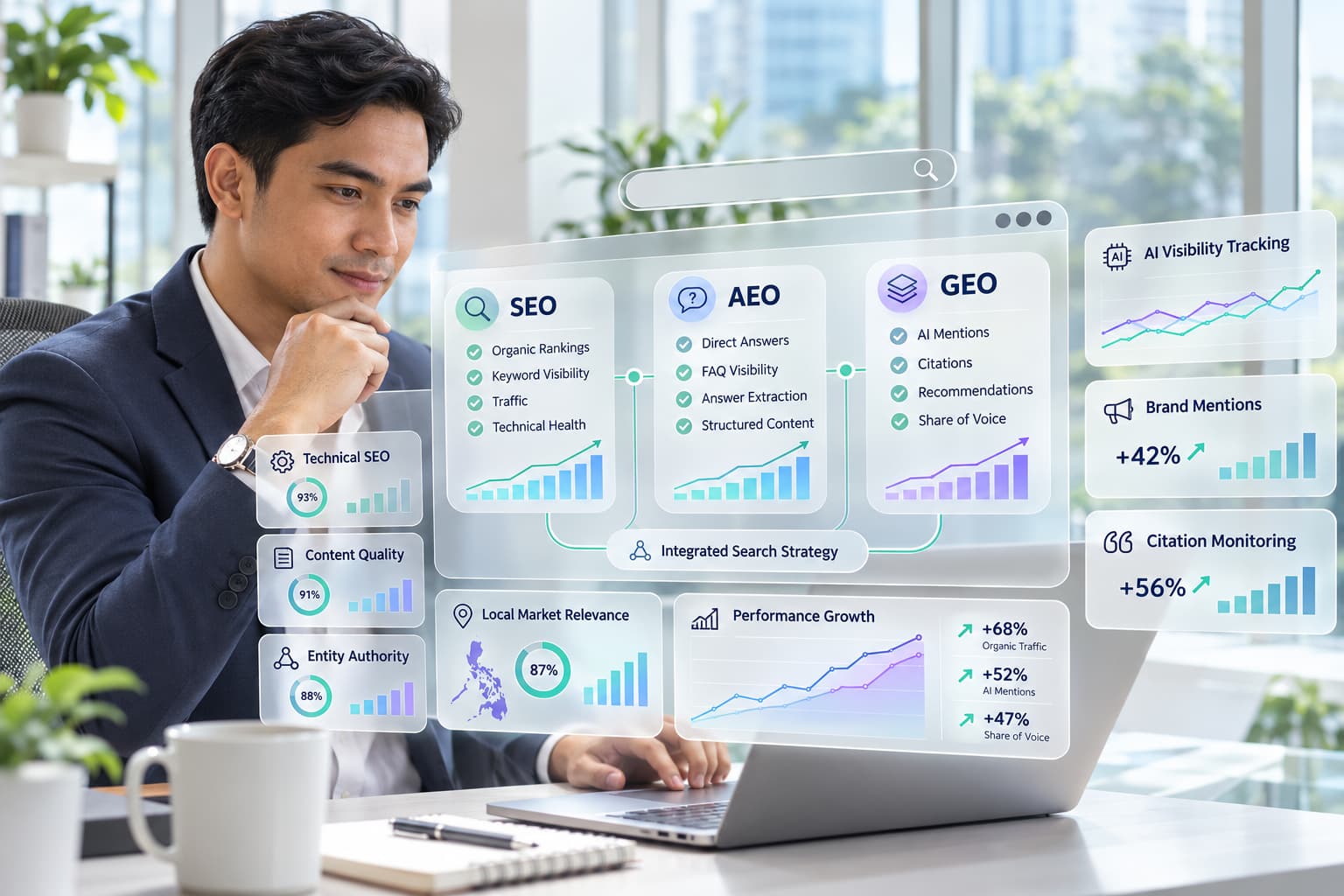
As a leading AI SEO agency in the Philippines, SEO Hacker combines traditional SEO with Answer Engine Optimization (AEO), Generative Engine Optimization (GEO), and proprietary Share of Voice tracking.
We work closely with your team to understand your business goals, listen to your priorities, and align our recommendations with your needs. Our approach strengthens your website’s technical foundation, content quality, and structure while identifying opportunities to improve search visibility.
Through AEO, we optimize content for Google AI Overviews and AI Mode, while GEO strengthens your brand’s presence in AI-generated recommendations and comparisons across ChatGPT, Perplexity, and Gemini. Share of Voice tracking monitors your visibility against competitors. By integrating SEO, AEO, and GEO, we build a strategy around your objectives and help your business adapt to AI-powered discovery.
Key Takeaway
Answering whether your business is ready for AI SEO starts with evaluating your website’s technical foundation, content quality, brand consistency, and internal resources. You don’t need to resolve every issue before hiring an agency, but clear objectives and reliable business information make campaign planning more effective.
With the right preparation and an integrated SEO, AEO, and GEO strategy, your business can build a stronger foundation for visibility across traditional search engines and AI-powered platforms.
Your customers are already changing how they search for products, services, and business recommendations. Is your brand prepared to appear where those decisions begin? Contact SEO Hacker now to assess your current search visibility and explore an integrated AI SEO strategy built around your business goals.