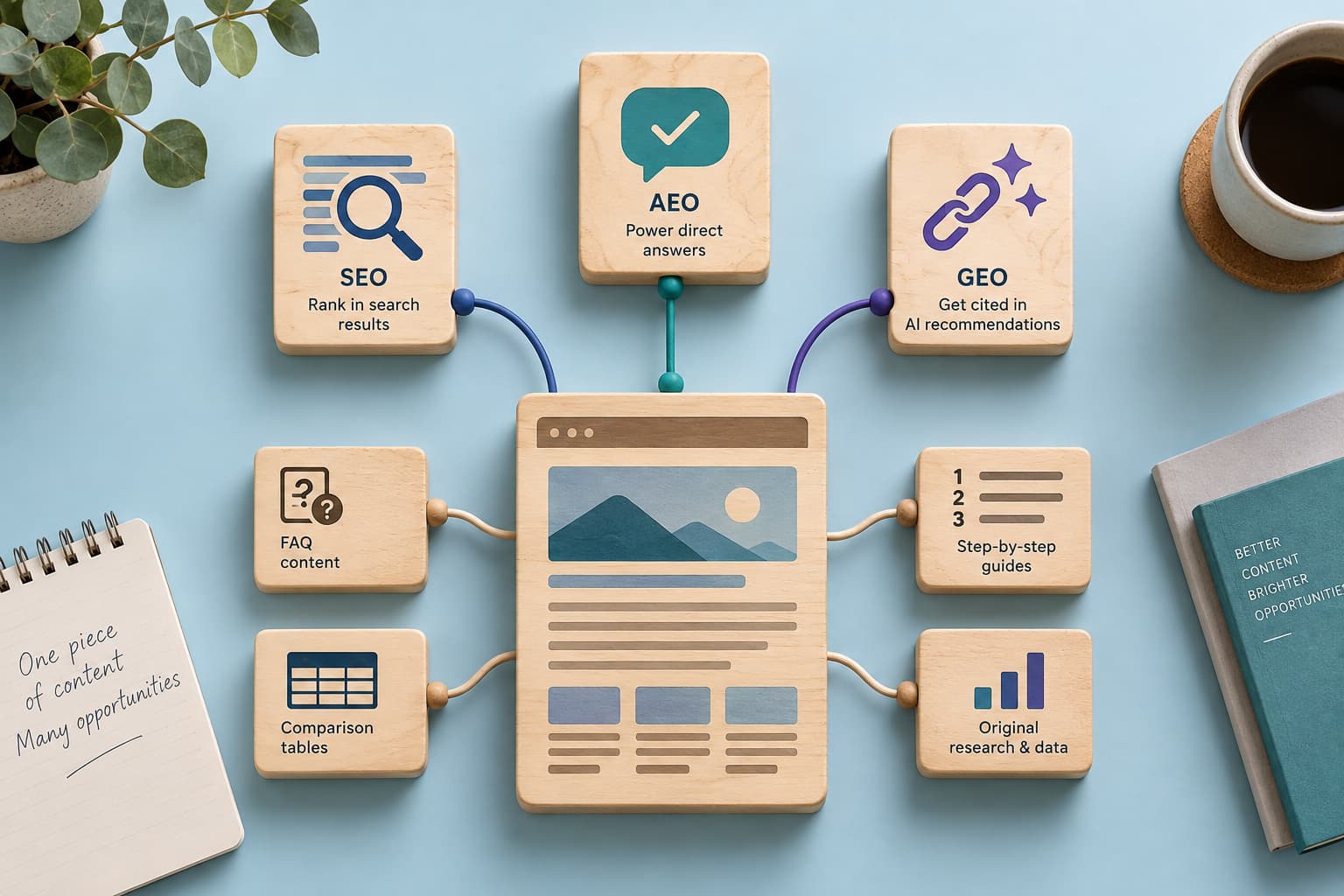
How can you strengthen your SEO strategy with AEO and GEO integration?
- Structure content for dual-purpose visibility
- Implement technical and schema enhancements
- Build topical authority and trust
- Expand your external digital footprint
Overview
- As AI-generated answers replace traditional links, businesses must integrate Answer Engine Optimization (AEO) and Generative Engine Optimization (GEO) with core SEO.
- By utilizing answer-first content, schema markup, high E-E-A-T signals, and external media coverage, brands build comprehensive authority that search engines and AI platforms trust, cite, and recommend.
Search results don’t look the way they used to, and the strategy that ranked you well a few years ago may not keep you visible today. AI-generated answers now sit above traditional results for many searches. This is where Generative Engine Optimization (GEO) and Answer Engine Optimization (AEO) come in.
Knowing how to strengthen your SEO strategy with AEO and GEO integration is how businesses are adapting to this shift, without abandoning the SEO fundamentals that still matter.
This approach builds on your existing foundation—aligning content, technical SEO, and off-site authority to ensure visibility wherever your audience searches.
Structure Content for Dual-Purpose Visibility
The way people encounter a search result has split in two: some still click into a page, and a growing number get their answer without ever leaving the results page. Nearly half of Google searches now surface an AI Overview, which means content written only to rank #1 in the traditional sense is already optimizing for a shrinking slice of the outcome.
By structuring pages with direct answers, descriptive headings, and clean lists, a single piece of content can seamlessly serve SEO, AEO, and GEO at the same time.
Implement Technical and Schema Enhancements

A solid technical SEO foundation—clean site structure, schema markup, and consistent business data—helps search engines and AI platforms accurately index, trust, and connect your brand information.
SEO Hacker’s services can help identify and address these issues, from improving site structure and crawlability to implementing schema and maintaining consistent business information. This ensures the technical side of your website supports the content you create, rather than creating barriers to visibility.
These signals work together to reduce ambiguity. Search engines can interpret and index your pages more accurately, while answer engines and generative AI platforms have clearer information to use when selecting or summarizing sources.
Build Topical Authority and Trust

One strong page is rarely enough to establish your website as a reliable source. Build a connected group of content around the topics your business wants to be known for. Cover related questions, explain key concepts, address common concerns, and link these pages together.
Building deep subject authority and strong E-E-A-T signals is critical for AI search visibility. With 96% of AI Overview citations tied to high-E-E-A-T sources (Wellows), brands must prioritize credible references, expert authorship, and original insights over content volume to stay visible across search engines and AI engines.
Expand Your External Digital Footprint
Your website is only one source that search engines and AI systems use to understand your brand. Other credible sources can also influence how search engines and AI systems recognize your expertise and relevance.
Muck Rack’s analysis found that 84% of AI citations came from earned media rather than brand-owned content, showing the role third-party sources can play in AI visibility. This makes it important to build your presence beyond your own website.
Building a consistent off-site presence complements on-site SEO by providing third-party proof of your expertise. Earning media coverage, participating in industry discussions, and keeping business listings uniform gives AI engines and search algorithms external validation to confidently cite your brand.
What Content Should You Create When Integrating AEO and GEO With SEO?
Once your strategy accounts for both traditional rankings and AI-generated answers, the next question is what to actually publish. The formats below are the ones consistently pulled into search results and AI responses alike.
Answer-First Guides
These guides give the answer first, then explain it. Readers and AI systems can quickly find the information they need. The supporting details come after the main answer. This format works well for broad “how” and “what” questions. It helps people who are still researching their options.
Detailed FAQ Sections
Answer real questions that buyers often ask. Give clear and specific answers instead of vague marketing statements. Each answer should make sense on its own. AI systems can easily use these complete answers in search results. FAQs can also address common concerns before a potential customer contacts you.
Comparison Tables
Comparison tables show different options side by side. This helps readers quickly see the differences without reading long paragraphs. They work well when people compare options. Use the same criteria for each option. Keep the language neutral so the information feels trustworthy.
Step-by-Step Frameworks
These guides explain a process in a clear, numbered order. They show readers exactly what to do and when. The structure also makes it easier for AI systems to understand and summarize the information. This shows you can put your advice into practice.
Research-Backed and Data-Driven Articles
Use original insights, reliable sources, and data to support your points. This makes your content more useful than generic advice found online. This type of content takes more time to create. However, it can help build trust with readers. It can also give AI systems stronger reasons to reference your content.
What Are the Common Mistakes When Integrating AEO and GEO With SEO?
Even well-intentioned teams stumble in the same handful of places when they try to bring AEO and GEO into an existing SEO strategy.
- Treating Strategies as Silos- Running SEO, AEO, and GEO separately sends search engines and AI systems mixed signals about your brand.
- Content and Formatting Pitfalls: Recycling old, keyword-stuffed content instead of restructuring it to provide direct answers keeps it invisible to AI systems.
- Technical and Ecosystem Oversights: Ignoring schema and off-site presence leaves AI systems without the trust signals they need to cite you.
How Do You Know If Your SEO Strategy Needs AEO and GEO?
Evaluate four key signals to determine if your search strategy needs to adapt to changing user behavior:
- Traffic is growing, but conversions remain flat.
- Content ranks on traditional pages but fails to earn Featured Snippets or instant answer boxes.
- Prospects frequently ask questions that your existing content doesn’t address.
- Competitors appear in ChatGPT, Perplexity, or AI Overviews, while your brand is omitted.
Key Takeaway
Knowing how to strengthen your SEO strategy with AEO and GEO integration comes down to a few consistent habits: structuring content for both readers and AI systems, cleaning up the technical and schema layer, building real depth around your topics, and extending your credibility beyond your own website.
Combined, these strategies build total trust and visibility across search engines and AI platforms. Partner with SEO Hacker to create an integrated approach that strengthens your brand for the AI era. Contact us today.