Overview
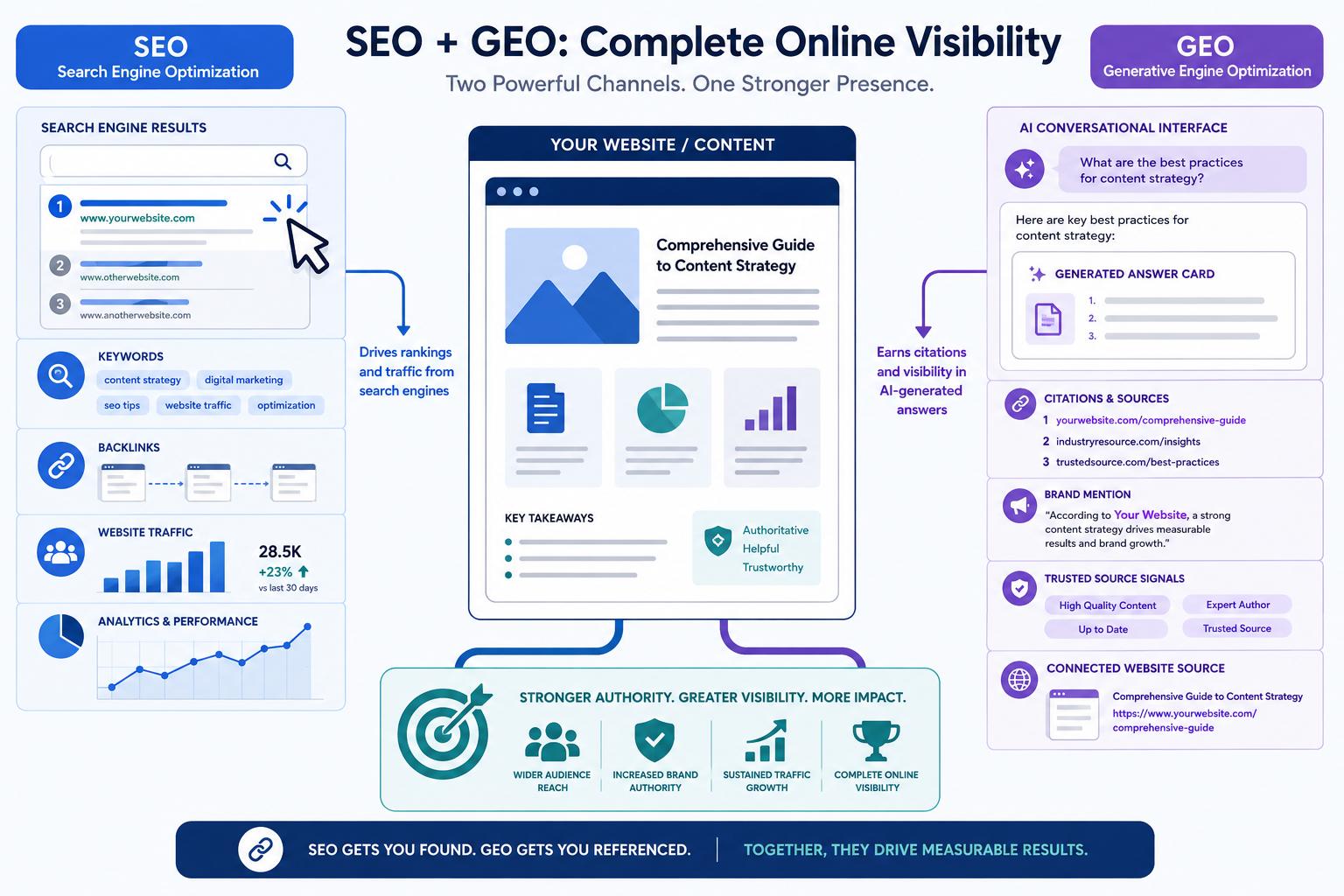
- This guide explains the difference between SEO and Generative Engine Optimization, how they work together, their key differences, best practices, and when your business should start investing in GEO to stay competitive in an AI-driven search landscape.
- While SEO remains essential for improving organic visibility, Generative Engine Optimization (GEO) helps your content appear in AI-generated answers and conversational search results.
Ranking on the first page of Google no longer guarantees the same level of traffic it once did. As AI-generated search experiences become more common, users are increasingly finding answers directly on search results instead of clicking through to websites.
Ahrefs reports that AI Overviews have reduced click-through rates for Google’s highest-ranking pages by up to 58%, highlighting how search behavior continues to evolve. As a marketing head, exploring the difference between SEO and Generative Engine Optimization helps you prepare your brand for these changes.
If you’re looking to improve your search performance, SEO Hacker offers strategic SEO services to help your brand stay competitive.
What is Search Engine Optimization (SEO)?
SEO remains a fundamental part of digital marketing, helping your website improve its visibility in organic search results through optimized content, technical performance, and site structure.
Despite the rise of AI-powered search, SEO continues to play a critical role in helping search engines understand your pages, increase qualified organic traffic, and connect your business with users actively searching for your products, services, or information.
What is Generative Engine Optimization (GEO)?
Generative Engine Optimization (GEO) is the practice of optimizing content for AI-powered search and answer engines so your brand can be selected and cited in generated responses. It extends visibility beyond page rankings into conversational search.
SEO vs. GEO: Key Differences
Understanding these distinctions helps businesses develop content that performs well across both traditional and AI-powered search experiences.
| Feature | SEO | GEO |
|---|---|---|
| Main Goal | Rank higher in search results | Become the answer in AI-generated responses |
| Target Platforms | Google, Bing, Yahoo | ChatGPT, Google AI Overviews, Gemini, Perplexity, Copilot |
| Query Format | Keywords and search phrases | Conversational, question-based queries |
| Key Signals | Keywords, backlinks, technical SEO, user experience | Context, authority (E-E-A-T), structured data, answer quality |
How SEO and GEO Work Together
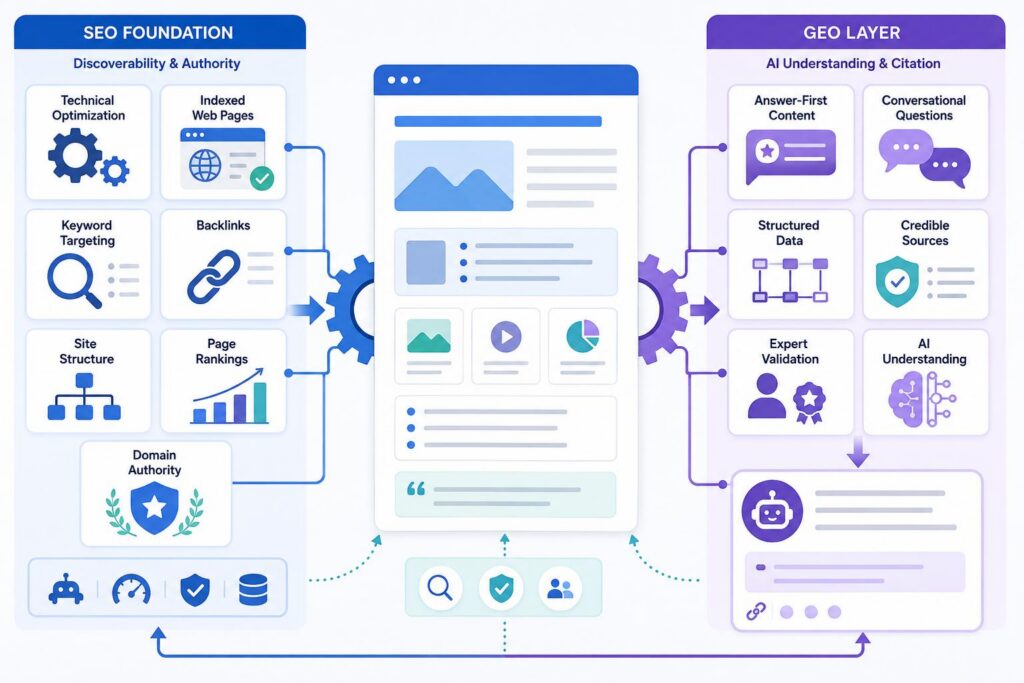
SEO and GEO aren’t competing strategies—they are complementary ones.
Traditional SEO gets your content indexed and ranked, while GEO ensures it is structured and credible enough for AI to extract and cite. Relying on just one creates a critical gap:
- SEO without GEO: Your content ranks on search pages, but AI answers ignore it.
- GEO without SEO: Your content is easy for AI to process, but lacks the domain authority to surface.
With 43% of consumers using direct-answer tools daily, combining both secures complete visibility. SEO builds your foundational authority, and GEO packages that authority so AI platforms confidently reference your brand across both traditional and AI-driven search experiences.
Best Practices for Combining SEO and GEO
Here are some best practices that strengthen your visibility and improve your chances of reaching users regardless of how they search.
Create Answer-First Content
Putting the answer at the beginning of your content makes it easier for both search engines and AI platforms to identify the information users need. Think of your content as a collection of clear, valuable answers rather than just a long article.
Each section should provide enough context to stand on its own, even when viewed separately. Using techniques like the inverted pyramid method, leading with the main takeaway before adding supporting details helps your content become easier to understand, scan, and extract. The goal is to make every section useful on its own while strengthening the overall message of your page.
Build Topical Authority
Publishing multiple pieces of content around a single subject helps establish your website as a reliable source of information. Rather than creating one article about SEO, expand your coverage with related topics such as technical SEO, keyword research, AI search, GEO, schema markup, and voice search.
These connected resources demonstrate deep expertise and offer vital context for both readers and search platforms. As your topic library expands, modern search systems gain confidence in citing your site for complex, industry-specific queries.
Optimize for Conversational Search
As search becomes more conversational, your content should reflect the way people naturally ask questions. Instead of relying on short keywords, structure your pages around question-based headings and follow each with a clear, 2–3 sentence answer before expanding on the topic.
When explaining processes, use numbered lists, and for comparisons or key points, use bullet points to improve readability. This format makes your content easier for both readers and AI platforms to understand, increasing its chances of appearing in conversational and AI-generated search results.
Use Structured Data
Structured data, or schema markup, gives automated systems clear context about on-page content. By tagging specific elements like articles, FAQs, products, reviews, and business details, it eliminates ambiguity and helps search engines process exact page intent.
A page with FAQ schema, for instance, clearly identifies questions and answers, allowing search engines and AI platforms to interpret the content more accurately. This added context increases your opportunities to appear in rich results, featured snippets, and AI-generated answers across different search experiences.
Strengthen E-E-A-T Signals
Generative search algorithms prioritize credibility. Search engines and answer models rely on Experience, Expertise, Authoritativeness, and Trustworthiness (E-E-A-T) to evaluate content quality. Pages backed by verified sources, first-hand expertise, and concrete data earn citations, while unsupported claims are filtered out of generated responses.
What Content Gets Ranked and Cited by AI?
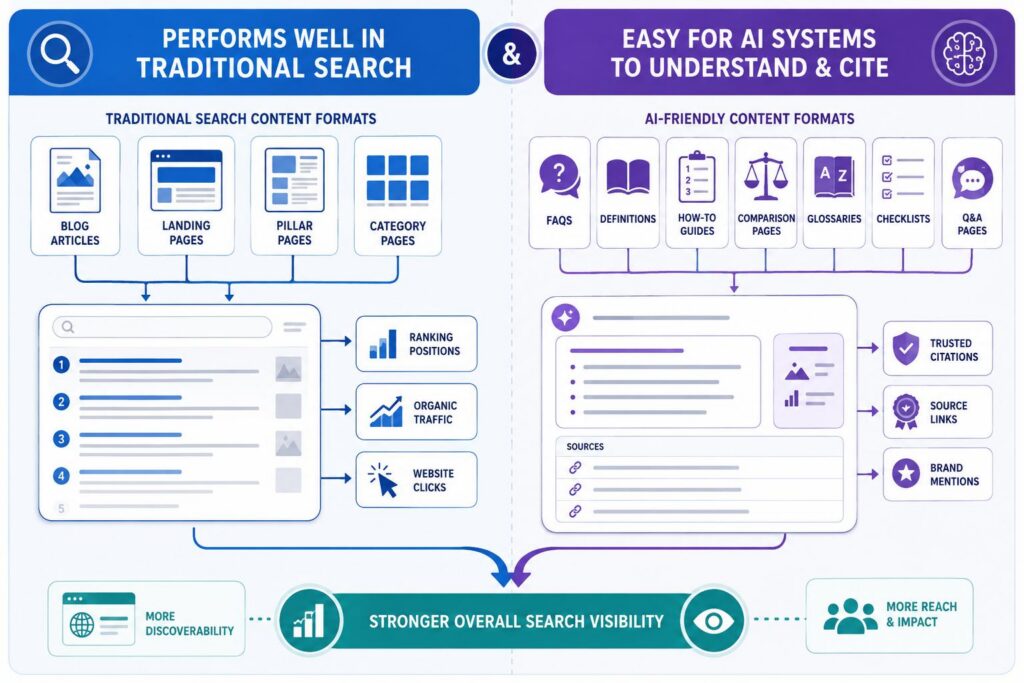
Different content formats serve different purposes, and choosing the right type helps maximize your visibility across both traditional search engines and AI-powered platforms.
Content That Performs Well in Traditional Search
These content types are designed to improve rankings, attract organic traffic, and support conversions.
| Content Type | Purpose |
|---|---|
| Blog Articles | Provide in-depth answers to user questions while targeting relevant keywords to drive organic traffic. |
| Landing Pages | Focus on specific products, services, or search intent to encourage conversions. |
| Pillar Pages | Cover a broad topic comprehensively and connect related content through internal linking. |
| Category Pages | Organize related products, services, or topics to improve navigation and search visibility. |
Content That Performs Well in AI-Powered Search
These formats emphasize clarity, structure, and direct answers, making them easier for AI systems to understand, reference, and cite.
| Content Type | Purpose |
|---|---|
| FAQs | Answer common questions with concise, straightforward responses. |
| Definitions | Explain concepts clearly, making key information easy for AI to identify and present. |
| How-To Guides | Deliver step-by-step instructions for users seeking practical solutions. |
| Comparison Pages | Present side-by-side evaluations to help users and AI quickly understand differences. |
| Glossaries | Define industry-specific terms to strengthen topical authority and improve AI comprehension. |
| Checklists | Summarize essential tasks, requirements, or best practices in an easy-to-scan format. |
| Q&A Pages | Compile frequently asked questions with direct answers, making content highly suitable for AI-generated responses and voice search. |
When Should Your Business Start Investing in GEO?
Here are some signs that indicate your business is ready to expand its strategy with Generative Engine Optimization (GEO).
- Your audience uses modern search tools: Engage users relying on conversational engines and interactive summaries that shape global search behavior.
- Your industry faces high search competition: Gain a competitive edge beyond crowded traditional result pages.
- You want visibility beyond organic rankings: Reach audiences across answer engines, voice assistants, and zero-click queries.
- You already have a strong digital foundation: Leverage your existing site architecture and authority to secure direct references.
Key Takeaway
The difference between SEO and Generative Engine Optimization (GEO) is that SEO improves visibility in traditional search results, while GEO helps your content appear in AI-generated answers and other AI-powered search experiences. Together, they create a stronger strategy for staying visible as search continues to evolve.
Search is evolving, and your strategy should too. SEO Hacker empowers businesses to maximize their online presence across traditional engines and next-generation AI search. Build sustainable growth that lasts; reach out to us today.