
What are the SEO mistakes that prevent your content from appearing in AI answers?
- Burying the answer
- Ignoring long-tail conversational queries
- Poor content structure
- Relying on missing or broken schema markup
- Lack of E-E-A-T and originality
- Inconsistent brand signals
Overview
- With billions of websites competing for visibility, SEO success now depends on structure, intent alignment, and technical optimization.
- Common mistakes like burying answers, weak structure, missing schema, and low E-E-A-T reduce chances of appearing in AI-generated results.
- Improving content clarity, authority, and consistency helps boost visibility in both search engines and AI-driven platforms.
As of March 2026, around 1.4 billion websites compete for online visibility, making publishing content alone insufficient. Success now depends on strong SEO structure and optimization. Without solid fundamentals, pages can be buried in search results and overlooked by both search engines and AI systems that determine what content is surfaced and cited.
To help you address this, this article will explore SEO mistakes that prevent your content from appearing in AI answers and how these issues directly impact your visibility in search rankings and AI-generated responses.
Burying the Answer

Placing key information too far down the page can reduce its chances of appearing in AI-generated answers. When answers are buried under long introductions or promotional content, both users and AI systems may struggle to quickly identify the main point. While supporting details remain important, AI platforms prioritize content that delivers a clear, immediate response before providing additional context.
If your page takes too long to answer a question, AI systems may choose another source that delivers the information more efficiently. For example, if someone searches “What is AEO?” and your answer only appears after several paragraphs, your content becomes harder for AI to extract and present.
Placing concise answers near the top of relevant sections improves readability and increases the likelihood that your content will be selected for AI overviews, featured snippets, and voice search results.
Ignoring Long-Tail Conversational Queries
Search behavior has evolved beyond short keywords. Today, users often ask complete questions such as “How can AEO improve my online visibility?” or “What is the difference between SEO and AEO?” These longer, natural-language searches are known as long-tail conversational queries. They closely reflect how people speak to AI tools, voice assistants, and modern search platforms.
AI systems prioritize context and intent, making conversational queries especially important. If your content does not address these natural questions, it may miss alignment with user search behavior.
Using question-based headings, FAQs, and conversational phrasing helps improve relevance and increases the likelihood of appearing in answer-driven search results across different stages of the user journey.
Poor Content Structure
AI platforms prefer content that is organized with clear headings, logical sections, short paragraphs, and easy-to-scan layouts. Large blocks of text, inconsistent formatting, and poorly structured pages make it harder for AI systems to identify key information and determine what should be surfaced as an answer.
Another common issue is relying heavily on unedited AI-generated content. While AI tools can help speed up content creation, publishing content without human review often results in generic explanations that lack unique perspectives and expertise.
AI platforms increasingly favor content that includes original insights, proprietary data, real-world experience, and expert knowledge. If your content looks similar to hundreds of other articles online, it becomes more difficult to stand out.
Relying on Missing or Broken Schema Markup
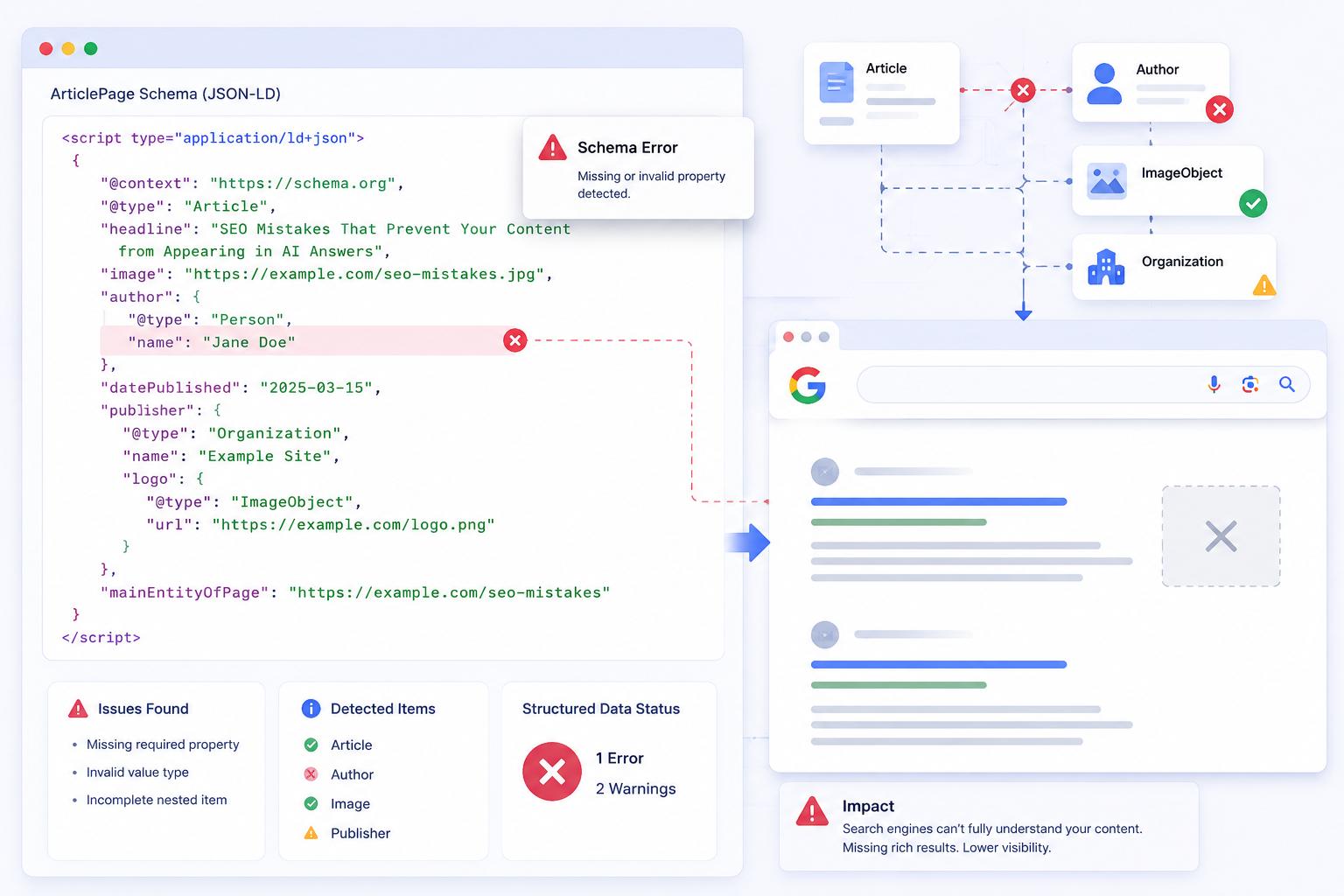
Schema markup provides additional context that helps search engines and AI systems understand what your content is about. It acts as a guide that explains whether a page contains FAQs, how-to instructions, product information, reviews, or other content types. Without proper schema markup, or when it is implemented incorrectly, AI platforms may struggle to interpret your content accurately.
Valuable content may miss opportunities in rich results, AI overviews, and voice search if structured data is missing. Without clear schema markup, visibility can decline even when content quality is high. Regularly maintaining schema ensures your content remains machine-readable and eligible for enhanced AI-driven search features.
Lack of E-E-A-T and Originality
AI platforms increasingly prioritize content that demonstrates Experience, Expertise, Authoritativeness, and Trustworthiness (E-E-A-T). Content that lacks credibility, supporting evidence, or real-world knowledge may struggle to earn visibility in AI-generated answers.
Strong E-E-A-T is built through demonstrated expertise, real industry experience, credible sources, case studies, and accurate information. Originality is equally important, as AI systems increasingly prioritize content that offers unique value over generic or repetitive material.
Content that includes fresh insights, proprietary research, or firsthand experience is more likely to be cited in AI-generated results. This improves visibility in AI-driven search while reinforcing your brand’s authority and trustworthiness.
Inconsistent Brand Signals
When your business information is inconsistent across websites, directories, social media, and other platforms, it can weaken your brand’s credibility and clarity. Conflicting or outdated details may also weaken the signals AI systems use to assess authority and relevance.
Maintaining consistency across your website, business listings, thought leadership content, and online mentions helps reinforce your expertise and trustworthiness. Consistent brand signals make it easier for AI platforms to connect information back to your organization and recognize your authority within your industry.
How to Fix SEO Issues for Better AI Visibility
Here’s how to fix common SEO issues so your content performs better in both search engines and AI-driven platforms.
- Improve structure and formatting – Use clear headings, concise paragraphs, and scannable layouts to make content easier for both users and AI systems to process.
- Strengthen topical authority – Expand coverage with related subtopics and commonly asked questions to improve relevance within your niche.
- Optimize for search intent – Align content with informational, transactional, and conversational queries to match what users are actively seeking.
- Add schema and technical improvements – Implement structured data and resolve technical SEO issues to help search engines and AI better understand and surface your content.
How SEO Hacker Fixes SEO Issues That Block AI Visibility
At SEO Hacker, we improve AI visibility by aligning keywords with user intent, analyzing competitors, and optimizing site structure.
We fix technical and on-page SEO issues, set up Google Analytics and Search Console, and strengthen content through optimized landing pages and consistent blogging. We also enhance authority through link building, UX improvements, and conversion-focused optimization for better search performance.
Key Takeaway
Avoiding these SEO mistakes that prevent your content from appearing in AI answers is essential for ensuring your website is structured, relevant, and authoritative enough to be surfaced by modern search and AI-driven systems. When technical SEO, content quality, and user intent alignment are properly addressed, your pages become easier to interpret, rank, and feature in answer engines.
To fix the SEO issues holding your visibility back, partner with SEO Hacker. Our team is ready to audit your website and identify critical gaps affecting your performance. Get in touch now and start building a stronger SEO foundation that improves your visibility and performance in search.