Overview
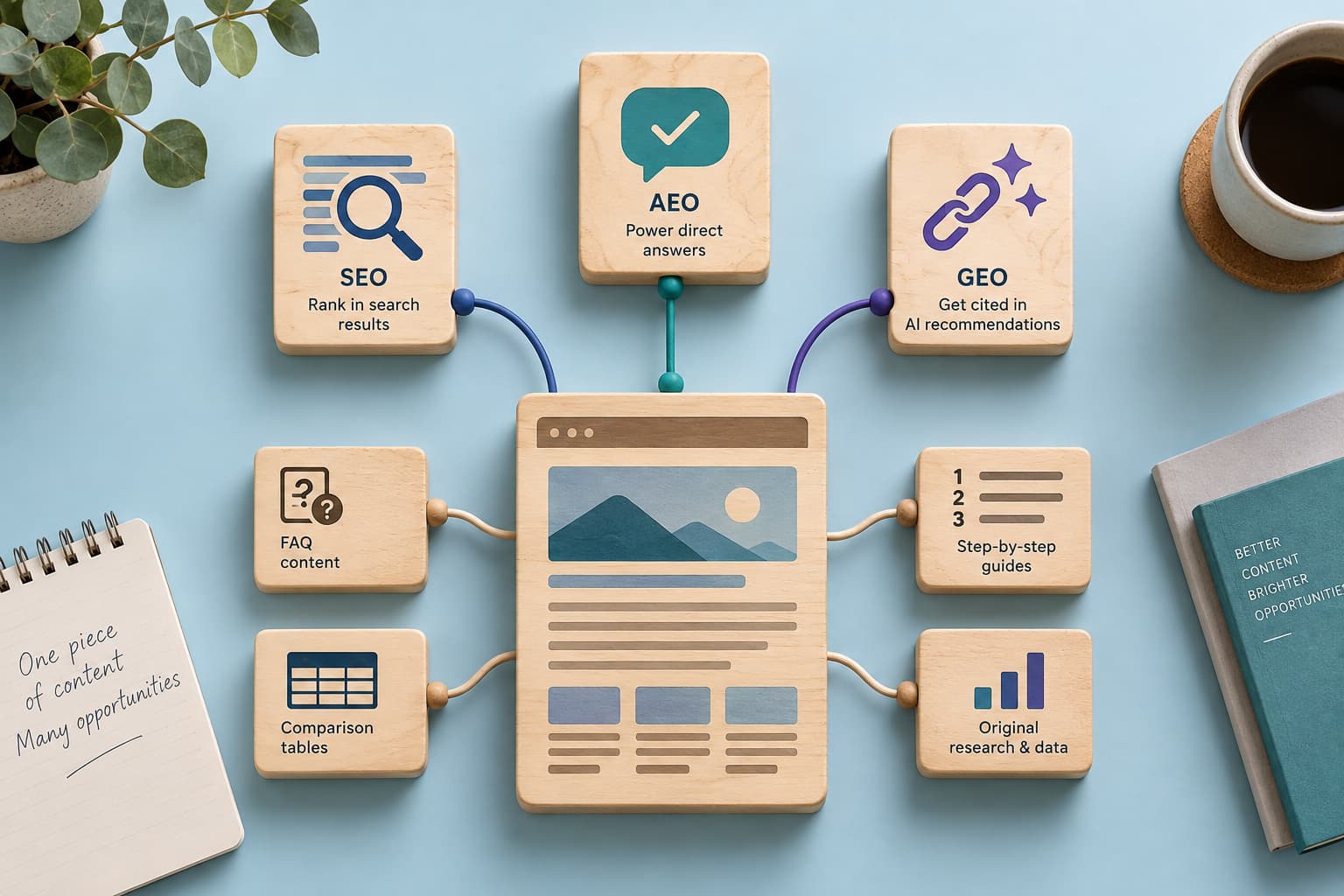
- SEO, AEO, and GEO each help your business get found in a different way, whether that’s ranking on Google, being the direct answer in a voice search, or getting cited by AI tools like ChatGPT.
- This article explains what each does, what an integrated strategy should include, and why running them together, not separately, gives your business stronger, more consistent visibility across every way customers search today.
Search is no longer just typing keywords into Google; customers now use voice assistants and AI tools throughout their buying journey. Because Google AI Overviews have already reduced organic clicks by 38%, high rankings alone no longer guarantee traffic. Businesses must adapt to maintain visibility.
That’s why SEO, AEO, and GEO must work together so your business stays visible whether customers are searching, asking, or being handed an answer directly.
What Roles Do SEO, AEO, and GEO Play in Search?
You need all three working together if you want your brand to show up no matter how people search, whether they’re typing into Google, asking a voice assistant, or prompting an AI tool.
- Search Engine Optimization (SEO) – You rely on SEO to help your website rank higher on traditional search engine results pages.
- Answer Engine Optimization (AEO) – When you want your content to be the direct answer voice assistants and search snippets pull from, AEO is what gets you there.
- Generative Engine Optimization (GEO) – GEO comes into play when you want AI tools like ChatGPT or Google AI Overviews to reference and recommend your brand.
What Should an Integrated SEO, AEO, and GEO Strategy Include?

Before you invest in any of these three approaches, it helps to understand the specific pieces that make them work together instead of competing for the same budget.
Technical & Traditional SEO (The Foundation)
Nothing else on this list matters if search engines can’t properly access and understand your website first.
Crawlability and Indexing
Important pages have limited chances of appearing in traditional search results when search engines cannot discover or index them. Crawling is how search engines find your pages, while indexing is how they store and organize them for retrieval; both affect the visibility of content supporting your SEO, AEO, and GEO efforts.
Technical issues like crawl blocks, broken links, and indexing errors hurt organic rankings and prevent AI systems from referencing your site. A well-indexed, easily crawlable site ensures search engines discover your pages and understand your content structure.
On-Page Optimization
Aligning content with user intent shapes performance across all search channels. Optimized titles, headings, URLs, and internal links provide clear topic context—improving traditional rankings, making answers easy for AEO extraction, and signaling domain authority for GEO recommendations.
A well-optimized page can therefore serve multiple search experiences at once, attracting organic visitors, answering specific questions, and giving AI systems useful information to reference.
Schema Markup
Schema markup is standardized code you add to your website that helps search engines understand context, for example, distinguishing a product price from a phone number.
Adding structured data schema earns eye-catching rich results—like star ratings and FAQ dropdowns—that boost click-through rates. When a developer or SEO specialist implements schema across key product, service, and location pages, it provides the machine-readable code search engines need to enhance your listing.
Answer Engine Optimization – AEO (The Answer Layer)
As more customers ask questions directly instead of typing keywords, your content needs to be structured to deliver clear answers, not just rank on a results page.
Direct Q&A Formats
Direct Q&A formatting helps answer engines and voice assistants extract concise, complete answers. By placing immediate responses directly beneath real customer questions, your brand captures prime zero-click placement and featured answer spots before users ever click through to a traditional search page.
FAQ (Frequently Asked Questions) Sections
A dedicated FAQ section captures high-intent search queries for answer boxes and AI responses while reducing repetitive support tickets. Sourcing real questions from sales calls and customer emails—formatted into clear question-and-answer pairs—positions your site as the definitive source for what prospects are actively asking.
Fact-Based Clarity
Clear, factual content is far easier for answer engines to extract and display. Because AI platforms skip promotional fluff in favor of verifiable statements, backing your copy with specific data, clear credentials, and credible sources helps ensure your business gets cited over competitors.
Generative Engine Optimization – GEO (The AI Citation Layer)
Beyond ranking or answering, your business also needs to be the kind of source that AI tools trust enough to cite by name.
Topical Authority
AI platforms assign authority based on how thoroughly you cover a specific subject. Building deep, consistent coverage around a focused set of core topics—rather than publishing broadly on unrelated subjects—signals true domain expertise, increasing your likelihood of being cited in generated answers.
E-E-A-T Signals
Google evaluates content quality using E-E-A-T (Experience, Expertise, Authoritativeness, and Trustworthiness). In generative search, AI tools actively favor credible sources over unverified claims. Clear author credentials, case studies, and backlinks from reputable sites provide the proof AI platforms need to cite your brand.
Ecosystem PR & Mentions
Credible mentions across press outlets and industry publications directly drive GEO success. Because AI tools pull from diverse online sources, active digital PR—such as expert roundups and media pitches—builds the widespread brand authority needed to earn AI recommendations.
How They Support Each Other
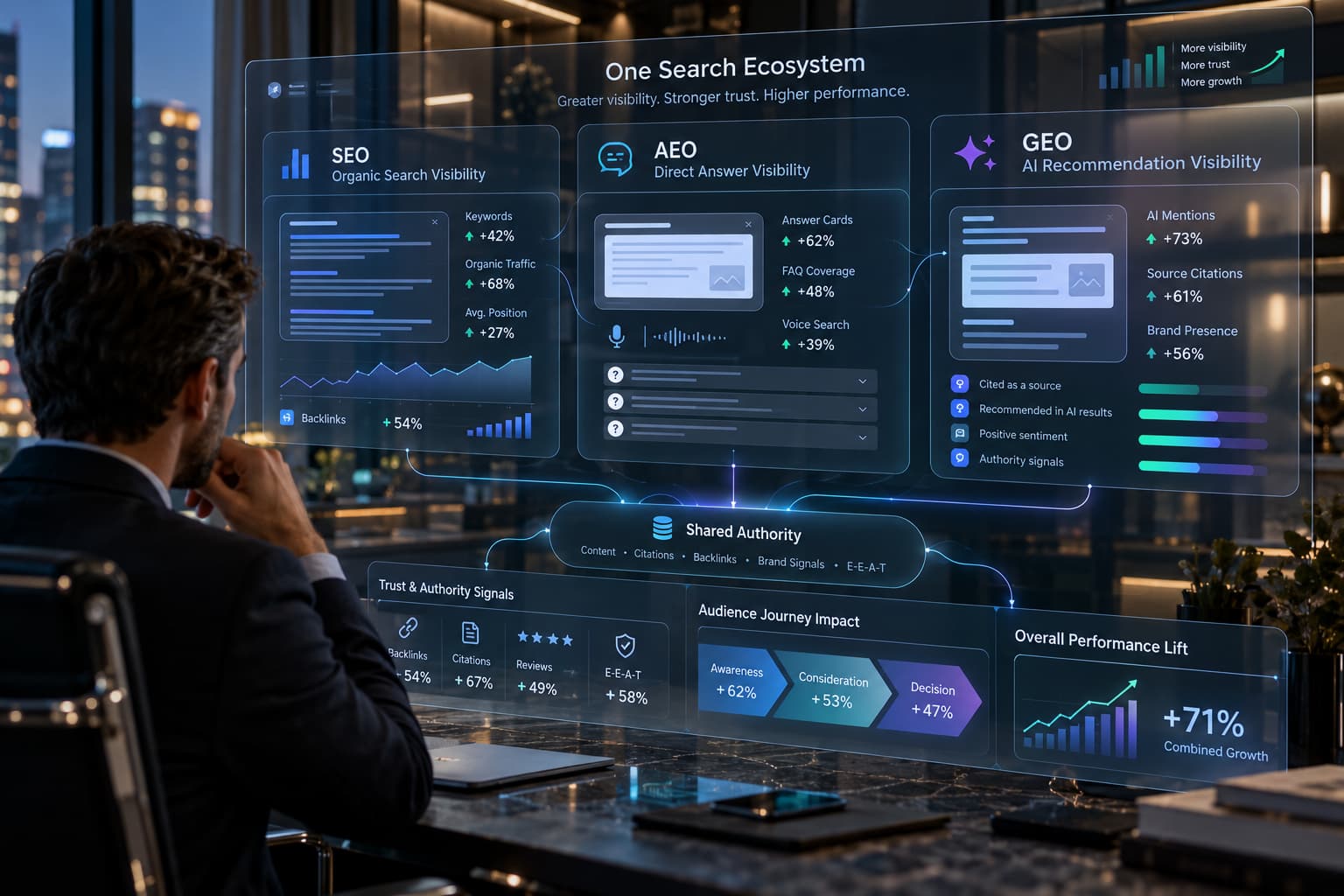
None of these three strategies work well in isolation, since each one strengthens the ground the others stand on.
When these three work as one system, you’re not just ranking on Google, you’re also showing up in voice search answers and getting recommended by AI tools. SEO Hacker’s AI SEO service brings SEO, AEO, and GEO together under one strategy, giving you a stronger, more consistent presence than any single approach can offer on its own.
Complete Funnel Coverage
SEO captures people actively researching and comparing options, AEO catches quick, specific questions along the way, and GEO positions your brand as a trusted recommendation when someone asks an AI tool for a suggestion. Covering all three keeps you visible at every stage, closing gaps competitors could otherwise fill.
Multichannel Trust
Showing up consistently across search results, answer boxes, and AI-generated responses signals that your business is reliable and established, not one customers stumbled on by chance. This repeated visibility builds familiarity, shortening the time it takes prospects to trust you, so your investment compounds as each touchpoint reinforces the last.
SEO vs. AEO vs. GEO: How They Work Together
Integrating SEO, AEO, and GEO creates a unified search presence that captures visibility across traditional link rankings, direct answer snippets, and AI-generated recommendations.
| Strategy | Primary Focus | Key Components | How It Supports Search Visibility |
|---|---|---|---|
| SEO | Traditional search visibility | Technical SEO, on-page optimization, structured data | Ensures your site remains accessible, relevant, and discoverable in organic search results. |
| AEO | Answer-focused visibility | Direct Q&A formats, FAQ sections, fact-based clarity | Position content as the primary direct answer for targeted customer questions and voice queries. |
| GEO | Generative AI search visibility | Topical authority, deep E-E-A-T signals, digital PR | Establishes brand credibility so generative AI platforms cite and recommend your content. |
| Integrated Strategy | Connected search visibility | Unified technical base, direct answers, and brand authority | Combines SEO, AEO, and GEO to maximize reach across traditional, answer, and AI search channels. |
Key Takeaway
Relying on just one strategy leaves gaps competitors can easily fill, so SEO, AEO, and GEO must work together to keep your business visible in every way customers search today.
A unified search strategy ensures your brand ranks on Google, delivers direct voice answers, and earns AI recommendations. SEO Hacker builds multi-channel strategies that maximize your reach across modern search engines and AI platforms—contact us today to future-proof your visibility.