Overview
- AI-powered search now delivers direct answers, making brand citations essential.
- Generative Engine Optimization (GEO) helps businesses get referenced by AI platforms through structured data, semantic content, consistent entity signals, and conversational formatting.
- Avoiding common branding and SEO mistakes strengthens credibility further. SEO Hacker helps brands build these GEO strategies to stay visible as AI search evolves.
Traditional search rankings are no longer enough. Today, AI-powered search delivers direct answers and brand recommendations—with Google’s AI Overviews appearing in over 21% of global searches. To stay visible, your business must be cited directly within AI-generated responses.
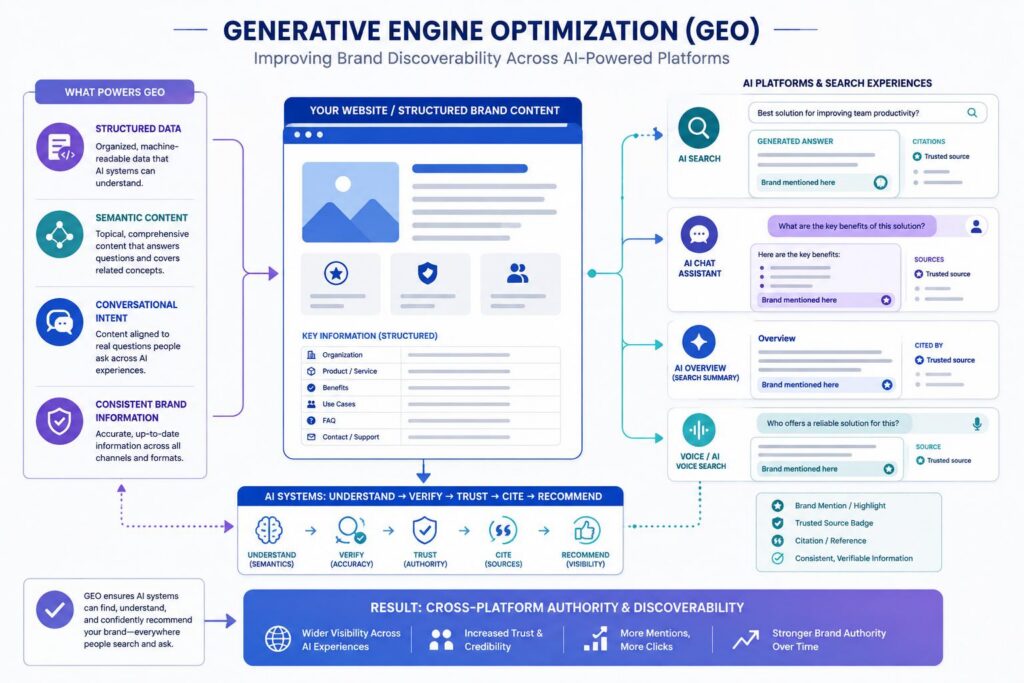
Understanding how Generative Engine Optimization (GEO) improves brand discoverability across AI platforms reveals how your business can adapt, maintain visibility, and thrive as search continues to evolve.
What is Generative Engine Optimization (GEO)
Generative Engine Optimization (GEO) adapts SEO principles for AI-powered search. While SEO targets search engine ranking links, GEO structures and validates content so AI models like ChatGPT, Gemini, and Perplexity cite your brand directly in generated answers. It secures visibility even when users receive responses without clicking through to websites.
How GEO Improves Brand Discoverability Across AI Platforms
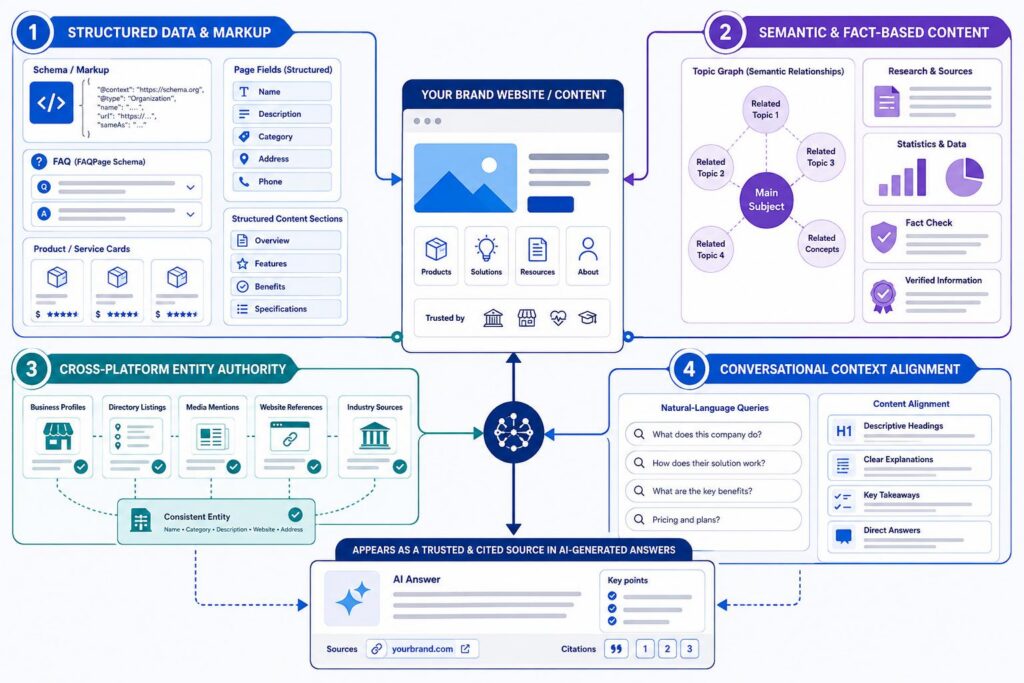
AI platforms don’t discover brands the way traditional search engines do — they interpret meaning, verify consistency, and prioritize sources they can trust and understand. GEO improves discoverability by aligning your content with exactly those signals. Here’s how.
Structured Data & Markup
Schema markup gives AI platforms a clear map of your content instead of leaving them to interpret it from surrounding text alone. By labeling elements like FAQs, articles, products, reviews, and business information, structured data helps AI systems quickly identify what a page is about and when it’s relevant to a user’s query.
This clarity increases your chances of appearing in AI-generated responses, rich results, and conversational search — keeping your brand visible as more search behavior shifts to AI-powered platforms.
Semantic & Fact-Based Content
AI platforms assess meaning and context, not just keyword matches. GEO improves discoverability by encouraging content that fully explores a topic with accurate facts, supporting detail, and related concepts — rather than a series of thin articles that each touch a subject briefly.
A page about email marketing, for example, can naturally cover audience segmentation, automation, open rates, and campaign analytics in one place. That breadth helps AI understand how these ideas connect, positions your content as a reliable resource, and improves the odds your brand gets surfaced across multiple AI platforms.
Cross-Platform Entity Authority
GEO builds entity authority by keeping your business details, expertise, and messaging consistent across your website, business profiles, directories, news mentions, and other reputable sources.
When AI platforms repeatedly encounter matching information about your brand, they gain greater confidence in recommending your business as a credible source. This consistency also helps AI distinguish your business from others with similar names or services. As your authority grows across the web, your brand becomes more discoverable and more likely to be referenced whenever users search for topics related to your expertise.
Conversational Context Alignment
Search behavior is shifting toward natural language, especially with AI assistants and chat-based tools. Instead of typing “best CRM,” users now ask, “What is the best CRM for a small business?” GEO aligns your content with this shift by answering questions directly, in clear and conversational language.
Structuring content around real user questions, using descriptive headings, and leading with direct answers makes it easier for AI platforms to understand your content — and to serve it when someone asks.
What AI Platforms Look for Before Mentioning Your Brand
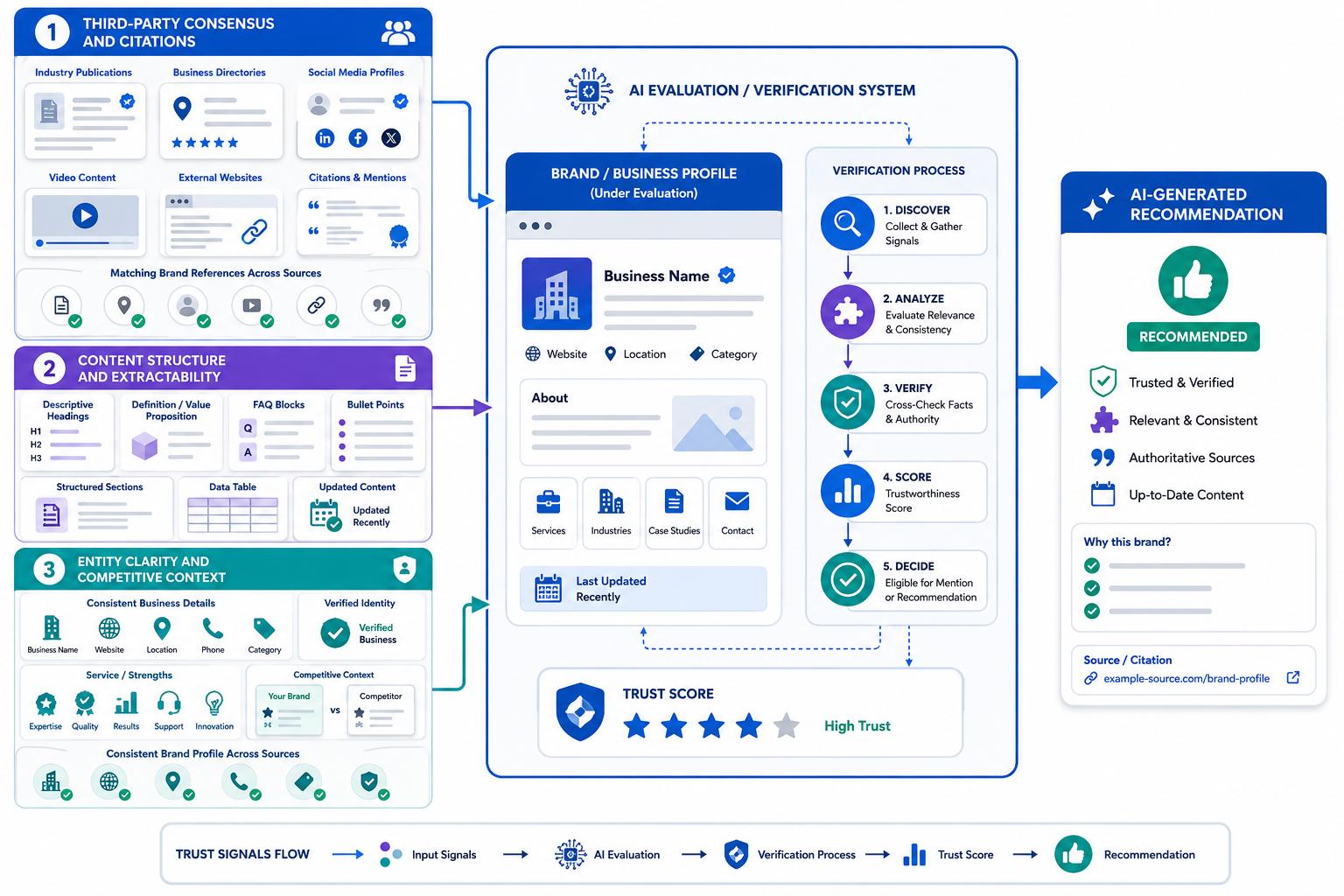
Before recommending a brand, AI systems weigh several trust and quality signals to decide whether your content is reliable enough to include in a response. Here’s what they’re checking.
Third-Party Consensus and Citations
Credibility isn’t built on your website alone. AI models cross-check your brand against reputable third-party sources — industry publications, business directories, Reddit, LinkedIn, YouTube, and other authoritative platforms — to verify what you claim about yourself. The more consistently your business shows up across these independent sources, the more confidence AI has in your expertise, and the more likely it is to reference your content in AI-generated answers.
Content Structure and Extractability
AI can only recommend what it can accurately understand and summarize. Descriptive headings, concise definitions, FAQs, bullet points, and tables make it easy for AI platforms to pull out key details quickly and correctly.
Keeping your cornerstone pages — the core pages covering your most important topics in depth — regularly updated signals ongoing relevance, which increases the odds AI selects your content over a competitor’s when answering related queries.
Entity Clarity and Competitive Context
AI needs to know exactly who you are before it can recommend you with confidence. Consistent business information across your website, social profiles, directories, and other listings reinforces a clear brand identity.
Comparison pages, “best for” guides, and content that spells out your specific strengths give AI the competitive context it needs to distinguish your business from similar ones — and to recommend it for the searches where it’s genuinely the best fit.
Types of Content That Improve AI Discoverability
Some content formats are easier for AI platforms to understand and reference, making them more likely to appear in AI-generated responses.
High-Performing Content Types
| Content Type | Why It Works |
|---|---|
| Original Research and Data Insights | Original surveys, stats, and case studies give AI unique data to cite, positioning your brand as an authority. |
| Comparison Content | Side-by-side comparisons help AI summarize key differences for users weighing options. |
| Structured FAQs and Q&A | Clear, direct answers to common questions make content easy for AI to extract in conversational search. |
| Step-by-Step Guides | Logical, sequential steps help AI surface procedural answers for “how-to” searches. |
| Glossaries and Definitions | Concise term definitions give AI a reliable reference for informational queries. |
Optimization Strategies for AI Extraction
| Strategy | Why It Works |
|---|---|
| Clear Heading Hierarchy | Descriptive H1, H2, and H3 headings organize content into sections AI can quickly navigate and understand. |
| Modular Formatting | Short paragraphs, bullet points, numbered lists, and tables make key information easier for AI to extract and summarize. |
| E-E-A-T Signals | Expert authorship, credible sourcing, and accuracy build AI’s confidence in referencing your content. |
Common Mistakes That Limit Brand Discoverability
Even well-written content can lose visibility without the right credibility and relevance signals — and many businesses make these mistakes unintentionally.
Strategic and Branding Pitfalls
| Mistake | Why It Hurts Discoverability |
|---|---|
| Trying to Appeal to Everyone | Broad, generic messaging makes it harder to connect with the specific audience your business is trying to reach. |
| Inconsistent Visual Identity | Different logos, colors, fonts, or messaging across platforms confuse customers — and make it harder for AI to recognize your brand as one consistent entity. |
| Copying Competitors | Replicating another brand’s content or messaging blurs your identity, making it harder for AI to distinguish and recommend you. |
| Focusing Only on Aesthetics | An attractive site isn’t enough without clear messaging, valuable content, and a defined brand strategy behind it. |
Digital and Technical SEO Mistakes
| Mistake | Why It Hurts Discoverability |
|---|---|
| Ignoring Keyword Optimization | Without relevant search terms throughout your site, search engines and AI platforms struggle to understand what your content is about. |
| Weak Site Structure and Speed | Slow load times, poor navigation, broken links, and a weak mobile experience limit how efficiently AI can crawl and process your site. |
| Random Publishing Patterns | Publishing unrelated content without a clear strategy weakens topical authority and makes your expertise harder for AI to recognize. |
| Neglecting Content Updates | Outdated statistics, broken information, or obsolete recommendations reduce your content’s relevance and credibility over time. |
How SEO Hacker Helps Improve Brand Discoverability
Traditional SEO alone isn’t enough as AI reshapes search. SEO Hacker builds strategies around high-quality content, technical SEO, structured data, and topical authority — making your brand easier for both search engines and AI platforms to understand, trust, and reference.
Key Takeaway
How GEO improves brand discoverability across AI platforms goes beyond increasing visibility; it helps position your business as a credible source that AI systems can confidently reference across different search experiences.
Want to strengthen your brand’s presence in the evolving search landscape? SEO Hacker creates data-driven search strategies that help your business stay competitive as AI-powered search continues to grow. Contact us now and take the next step toward improving your long-term online visibility.