Why does search intent mismatch hurt your AI visibility?
- Poor engagement signals
- Loss of AI overview citations
- The negative feedback loop
Overview
- Search intent is the purpose behind a user’s query, and aligning with it is essential for AI-driven visibility. When content misses intent, it can weaken engagement, rankings, and AI citations. Proper alignment improves relevance and increases the chances of being surfaced in AI-generated results.
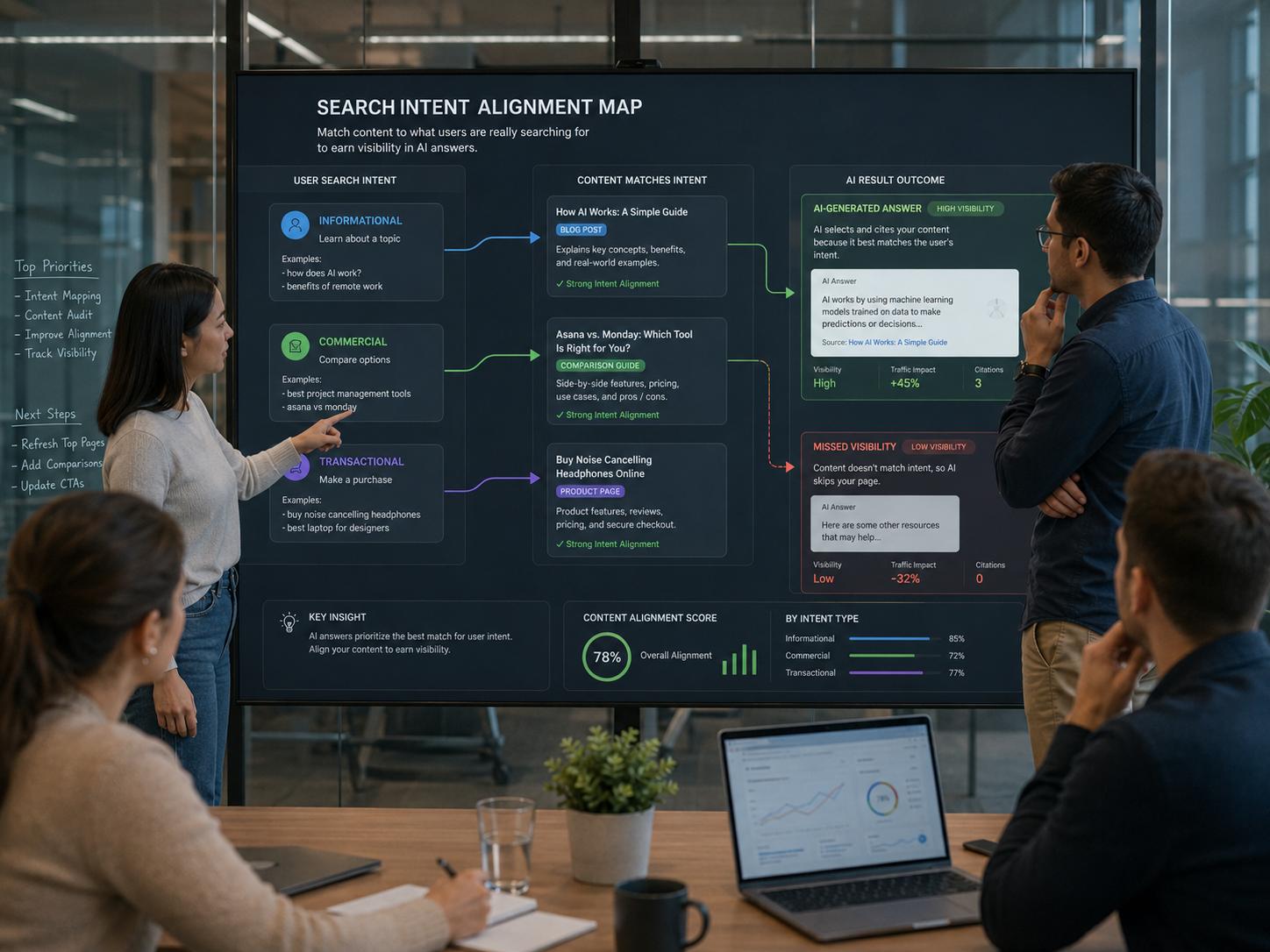
Search intent is the purpose behind a user’s query. It helps search engines and AI systems identify content that best meets user needs, whether they want answers, comparisons, or solutions.
As AI-driven search evolves, aligning content with intent is essential for visibility. Even content with relevant keywords may struggle if it does not match what users expect to find.
In this article, we will explore the reasons why search intent mismatch hurts AI visibility and how it affects your content’s ability to appear in AI-generated results.
Poor Engagement Signals
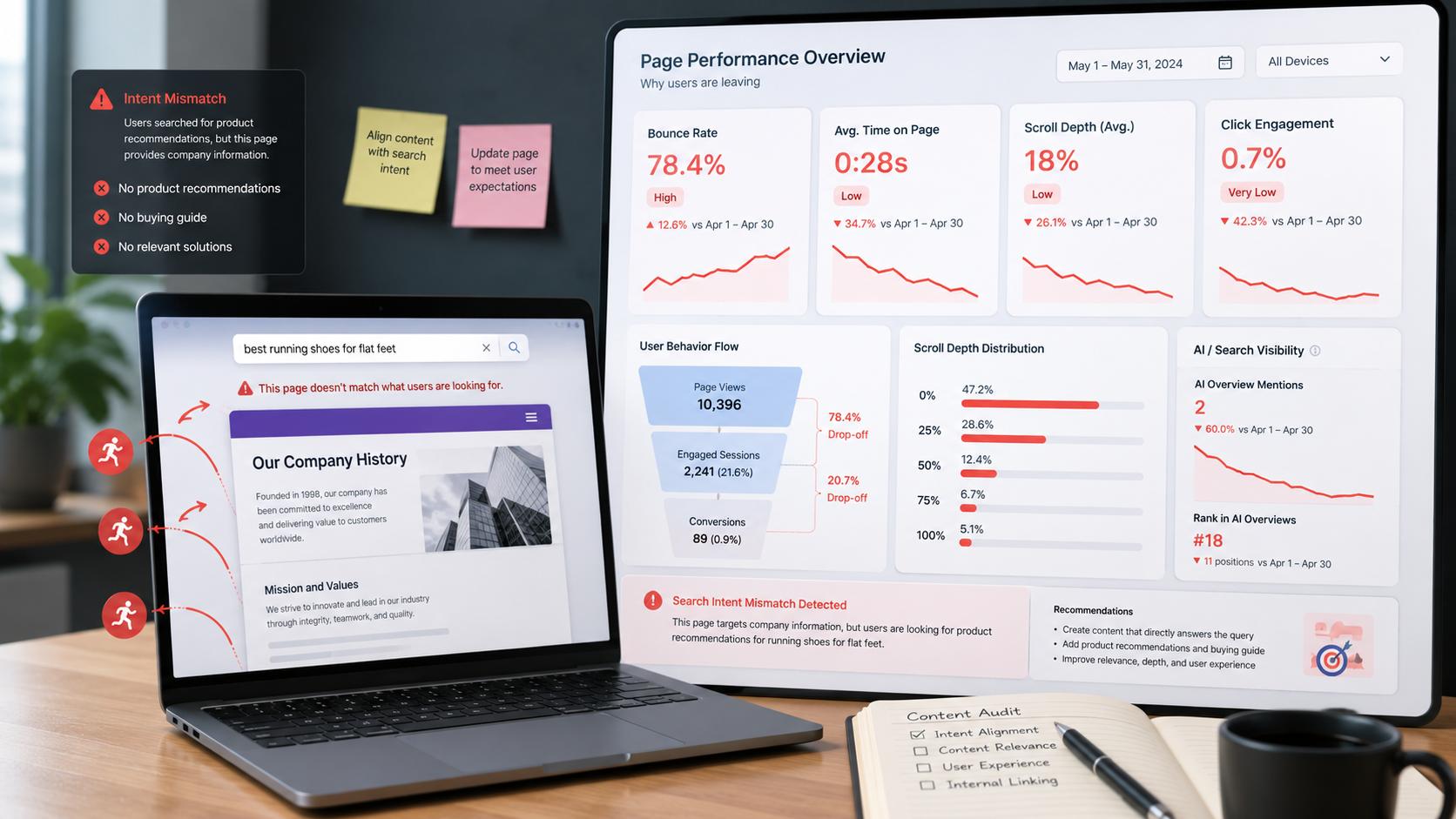
When content does not match search intent, users quickly realize that the page does not fully answer what they were looking for. This leads to weaker engagement signals such as shorter time on page, lower scroll depth, and higher bounce rates.
These behavioral patterns are increasingly interpreted as indicators of content quality and relevance. If users consistently leave without interacting further, it signals that the page is not effectively satisfying the query.
Over time, this can reduce visibility because search systems may perceive the content as less useful or misaligned with user intent.
Loss of AI Overview Citations
Search intent mismatch makes content less likely to appear in AI-generated summaries because AI systems prioritize information that directly and clearly answers the user’s query.
When content does not align with intent, it often lacks the clarity, depth, or focus needed for extraction and is bypassed in favor of more relevant competitors. In competitive industries, even high-authority pages may lose visibility if they fail to meet the exact informational need behind the search.
The Negative Feedback Loop
A mismatch between content and user intent can create a cycle that weakens visibility over time. It often starts when a page gains traffic but fails to meet user expectations.
As engagement drops, search systems may view the content as less relevant, leading to lower rankings, fewer impressions, and reduced AI visibility. Over time, this can weaken traffic, authority, and competitiveness in search results.
Signs Your Content Has an Intent Alignment Problem
Intent alignment issues often become apparent when content is visible yet underperforming. These signs can reveal whether your content is failing to match user intent in search and AI visibility.
Strong Rankings but Low Conversions
A page may rank well but fail to convert if it attracts users at the wrong stage or does not provide the next step they need.
For example, a user searching with comparison intent may expect product differences, pricing factors, pros and cons, or decision-making criteria. If the page only provides a broad overview, it may rank for the keyword but fail to move users toward action.
High Impressions with Low Clicks
High impressions with low clicks suggest your page appears in search results, but the title, meta description, or angle may not match user intent.
The issue may not be the page content alone. Sometimes, the search snippet fails to communicate relevance, value, or specificity. Users may choose competing results that appear more direct, helpful, or aligned with what they are trying to accomplish.
Content Not Appearing in AI Answers
A page can be indexed yet not selected by AI-powered search systems or answer engines. This often happens when the content does not provide a clear, structured, and complete answer to the user’s likely question.
AI systems favor clear, useful, and well-structured content. If your content is vague, overly promotional, or thin, it may be overlooked even when it ranks in traditional search results.
Poor Engagement Despite Traffic
Traffic alone does not mean content is meeting user intent. If visitors quickly leave, do not scroll, avoid clicking internal links, or fail to complete key actions, the page may not be delivering the information they expected.
Poor engagement may mean your content answers too slowly, lacks detail, feels too generic, or uses a format that does not match what users expected.
Common Causes of Search Intent Mismatch
Here are the key reasons why content often fails to align with user and AI search intent:
Targeting Keywords Without Intent Analysis
A common issue is choosing keywords based only on business relevance without understanding user intent. Without knowing whether users want to learn, compare, solve a problem, or take action, content can become overly general and fail to achieve the expected outcome.
Relying on Outdated SEO Strategies
Traditional SEO focused on keyword frequency and broad coverage, but modern search prioritizes clarity, relevance, and direct answers. Content that relies on outdated tactics may lack the depth needed to sustain visibility, especially in AI-driven search.
Focusing Only on Search Volume
High search volume shows demand, but it does not guarantee intent alignment or conversions. Content planned around volume alone often becomes too broad and attracts users who may not be ready, qualified, or looking for the exact solution offered.
Lack of Audience Research
Effective intent alignment requires understanding the user’s knowledge level, concerns, and decision-making stage. Without this insight, content may seem complete but still fail to answer the real questions users have.
Misaligned Content Format
Using the wrong format can weaken content performance, even when the topic is relevant. Guides, comparisons, landing pages, and FAQs each serve different intents, so the structure must match what users expect from the query.
How to Fix Search Intent Mismatch
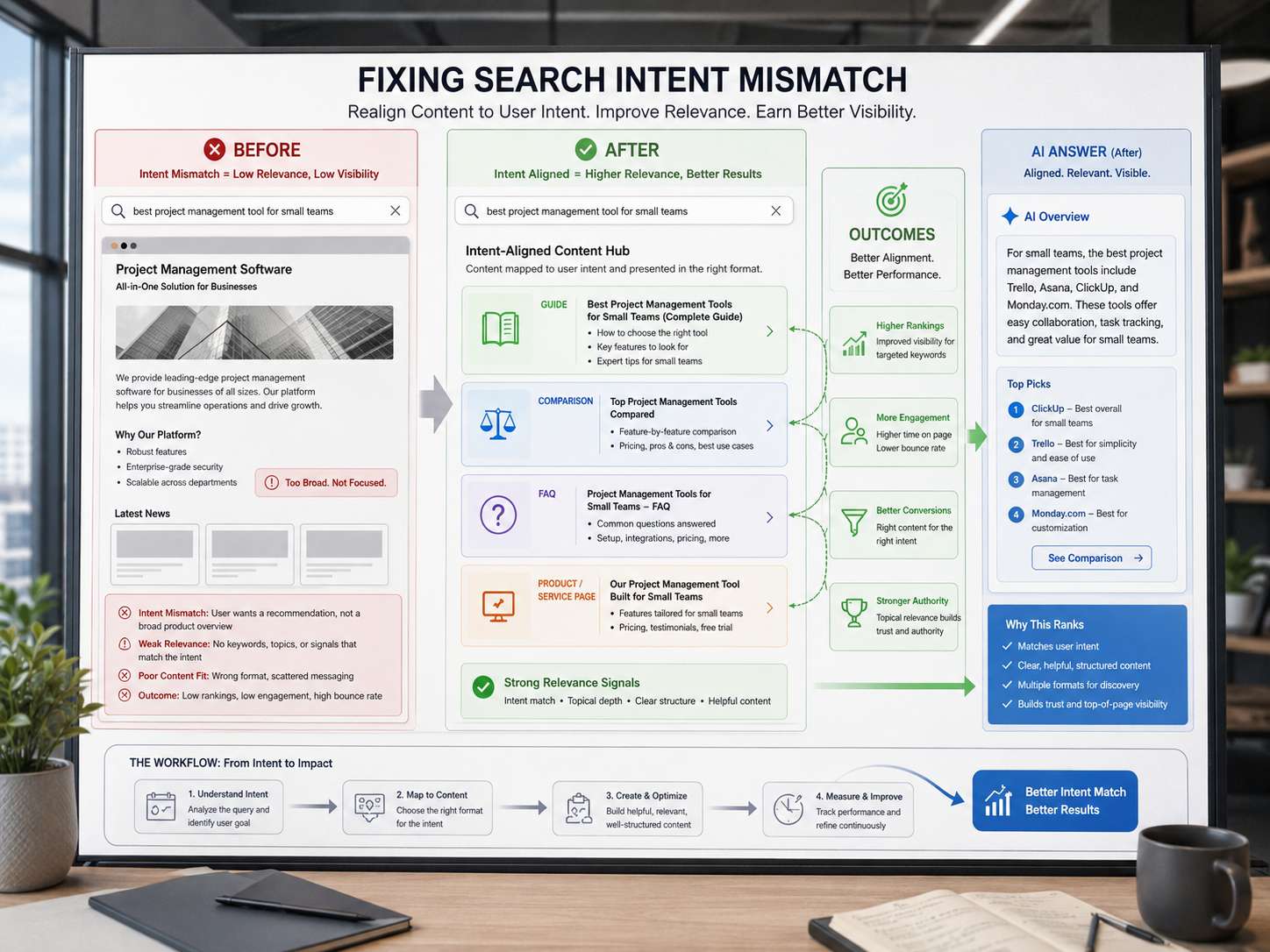
Fixing search intent mismatch means aligning your content with user expectations and search system signals through clearer purpose, structure, messaging, and next steps.
Identify The Mismatch
To keep your search traffic, your content format must match what users expect on the results page. If people are searching for step-by-step guides but land on a product sales page, they will immediately leave. You can spot these issues in Google Search Console by looking for pages with high impressions but low clicks; this gap means your title or format is mismatched, which ultimately hurts both your click-through rate and your visibility in AI search results.
Classify The Intent
Once you identify a mismatch, classify the keyword’s intent to determine the correct content format. Clear intent helps both users and AI systems understand your page, preventing it from trying to serve too many purposes at once.
- Informational: guides, tutorials, FAQs.
- Navigational: brand pages or specific site destinations.
- Commercial: comparisons, reviews, buying guides.
- Transactional: product pages, pricing, booking or checkout flows.
Realign Your Content
After identifying an intent gap, restructure your page to match what users expect from the query. If they want guidance, use a blog or how-to format; if they are comparing options, use tables and lists; if they are ready to buy, direct them to a product or service page. To boost AI visibility and usability, place a direct answer near the top, use clear headings, and define key terms so search systems can easily interpret the page.
Optimize The User Experience
Even with the right information, a page will underperform if it is poorly structured or hard to scan. To improve readability and give AI systems clearer signals, use descriptive headings, short paragraphs, comparison tables, and FAQs. Ensuring the page matches both the query and the user journey boosts its visibility across both traditional search results and AI-generated answers.
How SEO Hacker Improves Intent Alignment for AI Visibility
Intent alignment involves more than targeting keywords. It requires relevant content, strong technical foundations, and authority-building efforts. Here’s how SEO Hacker helps improve visibility in search and AI-driven results:
- Keyword and intent mapping – We align keywords with user intent to ensure each page targets the correct search purpose
- Content optimization – We refine content to clearly answer user queries and improve relevance for both search engines and AI systems
- Technical SEO support – We resolve technical issues that may prevent search engines and AI from properly understanding your content
- Authority-building strategies – We strengthen your site’s credibility through high-quality signals that improve trust and visibility in AI-generated answers
Key Takeaway
Understanding why search intent mismatch hurts AI visibility comes down to how well your content aligns with what users are actually searching for.
When intent is unclear, search engines may struggle to identify your content as the most relevant answer, resulting in lower visibility, weaker engagement, and reduced search performance.
SEO Hacker can help realign your content with the right intent and optimization strategy. Partner with us today and build content that performs in both search rankings and AI answers.